




Summary
Pay increases in 2026 are holding steady. Economic uncertainty, employee expectations for merit increases to exceed inflation, and a weakening labor market are forcing employers to make careful, data-driven pay decisions.
The Payscale 2026 Compensation Best Practices Report, released in the first quarter of 2026, provides one of the clearest views into how organizations are approaching salary increases, merit pay, and across-the-board raises for the year ahead.
Organizations that relied on Payscale’s 2025–2026 Salary Budget Survey at mid-year to inform compensation planning for pay increase budgets will find reassuring consistency in the latest data. Overall salary increases have not shifted materially and have not changed since last year.
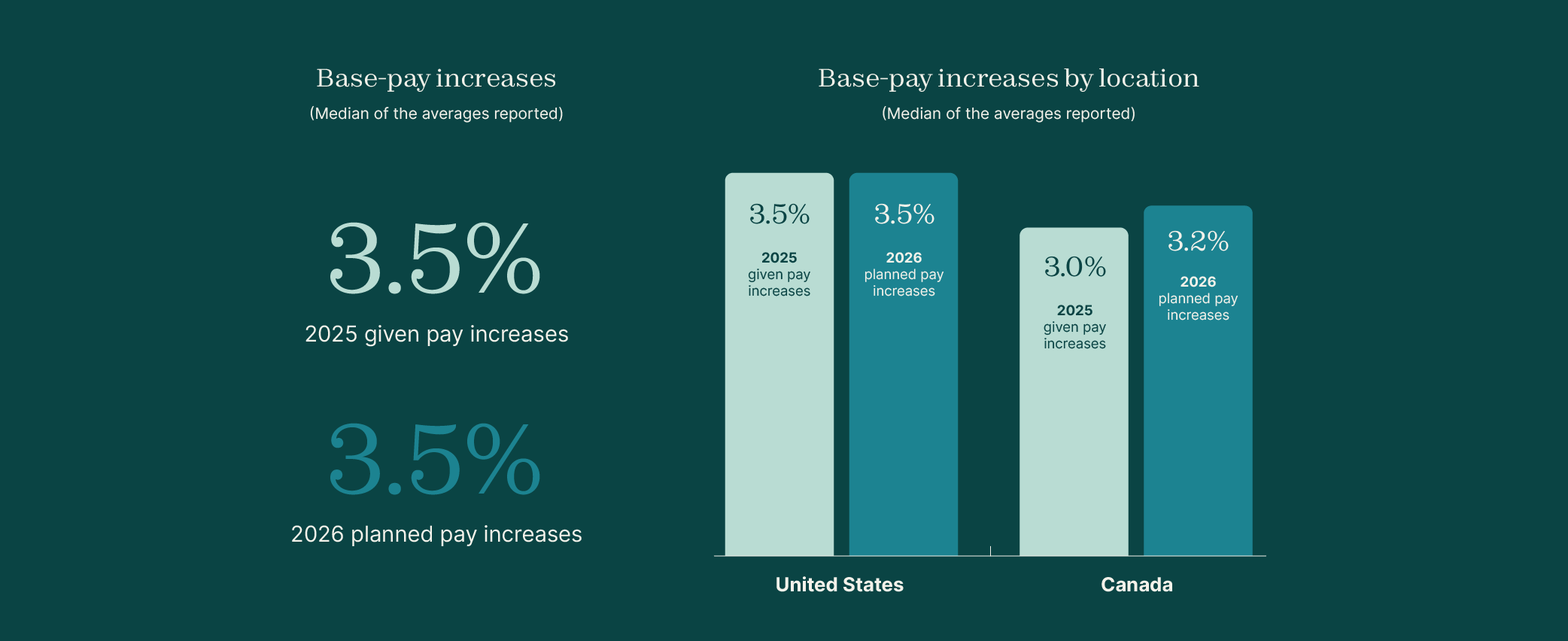
Median base-pay increases overall:
- 2025 given base-pay increases: 3.5%
- 2026 planned base-pay increases: 3.5%
Salary increases by location: U.S. vs. Canada
As in prior years, pay increase expectations differ by geography, with the United States giving higher pay increases than Canada.
.png)
Although salaries are primarily set based on the cost of labor rather than the cost of living, cost-of-living considerations still influence annual salary increases for many organizations. In 2026, 45% of organizations factor cost of living into pay decisions overall — 43% in the United States and 60% in Canada.
Notably, while Canadian organizations are projecting lower salary increases than those in the United States, these increases are higher relative to inflation. In contrast, U.S. organizations place greater emphasis on merit/performance, with 78% using these factors to determine salary increases compared to 60% in Canada.
Inflation trends help explain these differences. In the United States, inflation — as measured by the Consumer Price Index (CPI) — eased to approximately 2.7% annually by late 2025, down significantly from peaks above 8% in 2022 but still above the Federal Reserve’s 2% target. In Canada, inflation held steady at 2.2% in November 2025, aligning with the Bank of Canada’s target, although food prices remain elevated.
Overall, merit/performance is the most influential driver of pay increases for organizations (76%), followed by market adjustments to remain competitive with the cost of labor (46%).
Additional factors affecting pay decisions include minimum wage increases, pay compression adjustments, tenure, internal pay equity adjustments, pay increases to reward education or skills, and changes in employee location, depending on an organization’s compensation strategy. Collectively, these result in total pay increases, which are independent of promotions.
Shift toward “peanut butter” across-the-board pay increases
One of the most closely watched compensation trends for 2026 is growing interest in across-the-board salary increases in certain sectors or job types, sometimes referred to as “peanut butter increases.”
Traditionally, salary increases are tied to performance ratings. While merit pay is still a best practice, performance ratings-based salary increases have faced criticism in recent years for being subjective, bias-prone, and administratively complex, especially in a volatile labor economy that faces economic uncertainty. Some organizations, particularly those with large frontline or lower-wage populations, are rethinking their compensation differentiation as inflation continues to affect workers unevenly.
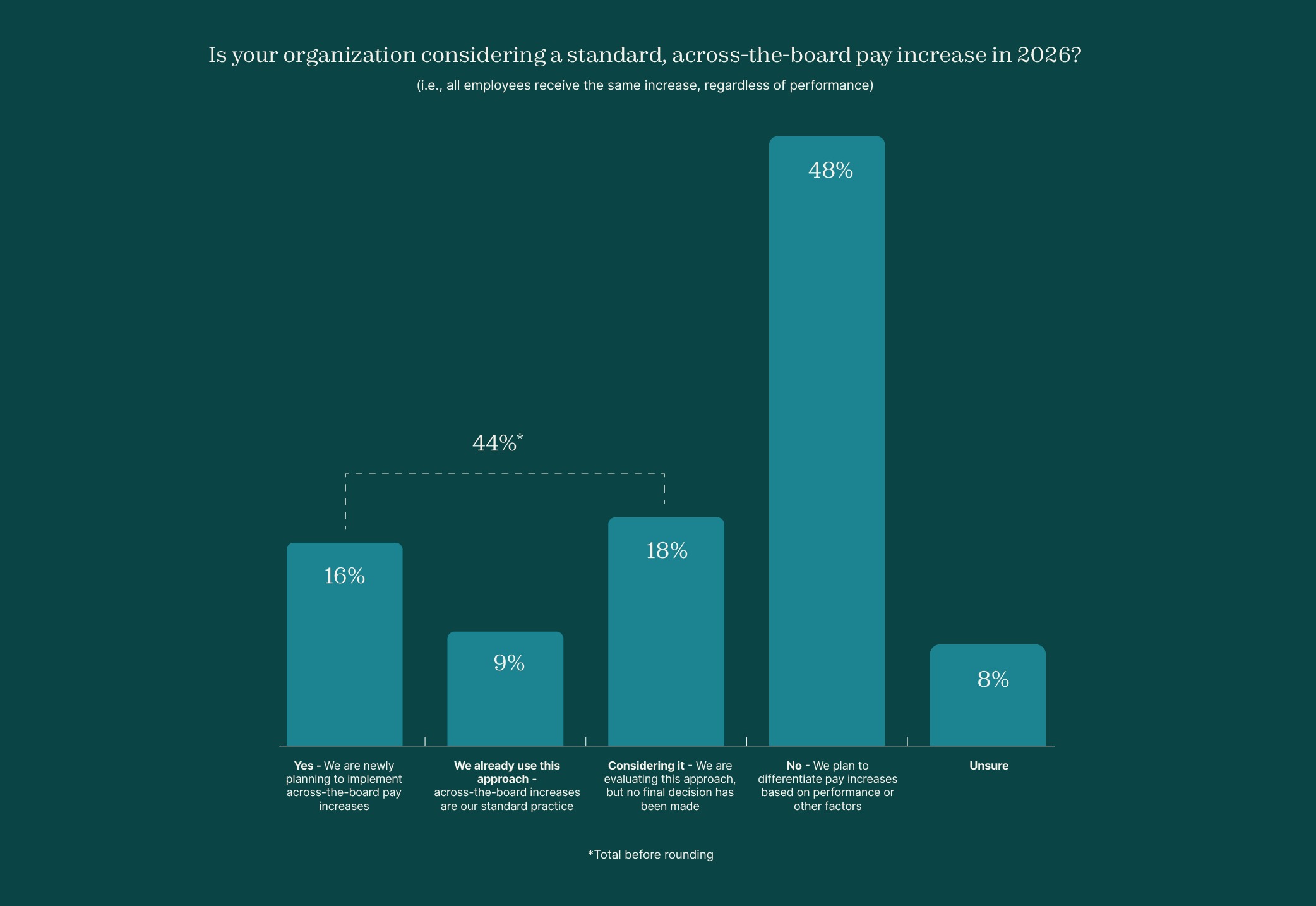
According to new research from Payscale’s 2026 Compensation Best Practices Report:
- 48% of organizations plan to continue pay increases based on performance
- 18% of organizations are considering peanut butter pay increases
- 16% of organizations are newly planning to implement peanut butter increases
- 9% of organizations already use peanut butter increases as their approach
- 8% of organizations are unsure
.png)
In total, more than 40% of organizations are either using or actively considering standardized across-the-board or peanut butter pay increases in 2026. This increases to 56% for top performers (organizations who reported that they would exceed their revenue goals in 2025).
Confidence in pay increases
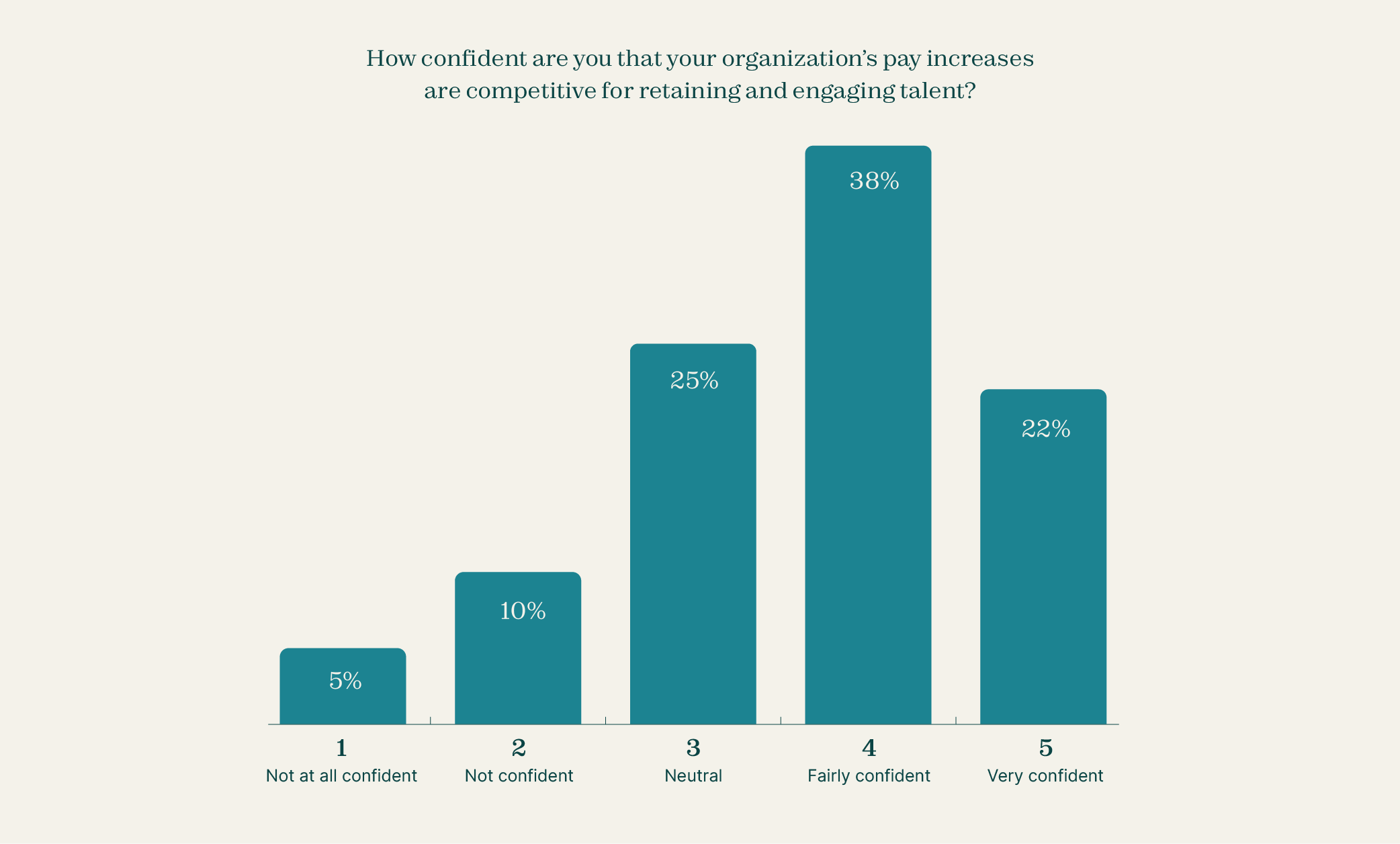
Even amidst change and uncertainty, most employers (60%) believe their 2026 salary increases are competitive to retain and engage talent. This suggests that while salary budgets are flat, employers feel positively about how effectively pay increases are being allocated. Confidence is even stronger for Payscale customers, where 70% report being fairly or very confident that their pay increases are competitive to attract and retain talent.
How confident are organizations in the competitiveness of pay increases to attract and retain talent?
- Very confident: 22%
- Fairly confident: 38%
- Neutral: 25%
- Not confident: 10%
- Not at all confident: 5%
.png)
What salary increase trends mean for 2026
For HR and compensation leaders, the takeaway is clear: confidence in pay increases isn’t driven by higher budgets but by having the right data and compensation strategy to ensure pay decisions align with market rates and can be explained to employees using data.
In summary:
- Salary increase budgets are stabilizing
- Geographic differences remain significant
- There is debate over fairness, bias, and simplicity in compensation management
- There is a shift away from merit-based pay increases during economic volatility
- Salary increases backed by market data are more important than ever
Get the Pay Increase Preview Report
Payscale’s Pay Increase Preview Report includes more survey data to help HR and compensation teams build confidence in compensation planning and pay communications, including:
- Salary increase data by company size
- Salary increase data by industry
- The factors the go into salary increases
- Peanut butter salary increases by industry
.avif)
Related resources
Sign up to receive the 2026 Compensation Best Practices Report
Sign up to participate in the 2026-2027 Salary Budget Survey


Need assistance with compensation planning?
Payscale helps organizations make fair, transparent, and market-informed pay decisions — so you can compete for talent with confidence.