


As organizations move into 2026, compensation planning is less dramatic than during the height of post-pandemic volatility, but that doesn’t mean it’s simple. Employers are navigating economic uncertainty, evolving employee expectations, and a labor market that is no longer red-hot but still competitive for critical skills.
The 2026 Pay Increase Preview Report provides an early look at data from Payscale’s 2026 Compensation Best Practices Report to help organizations approach pay increases in 2026. The takeaway is that salary budgets are holding steady, but the methodology for pay increases is shifting in certain sectors.
This matters not just for budgets, but for how HR and compensation leaders communicate pay decisions, manage fairness, and maintain trust with employees.
Salary increases are stable, and that stability is intentional and desirable
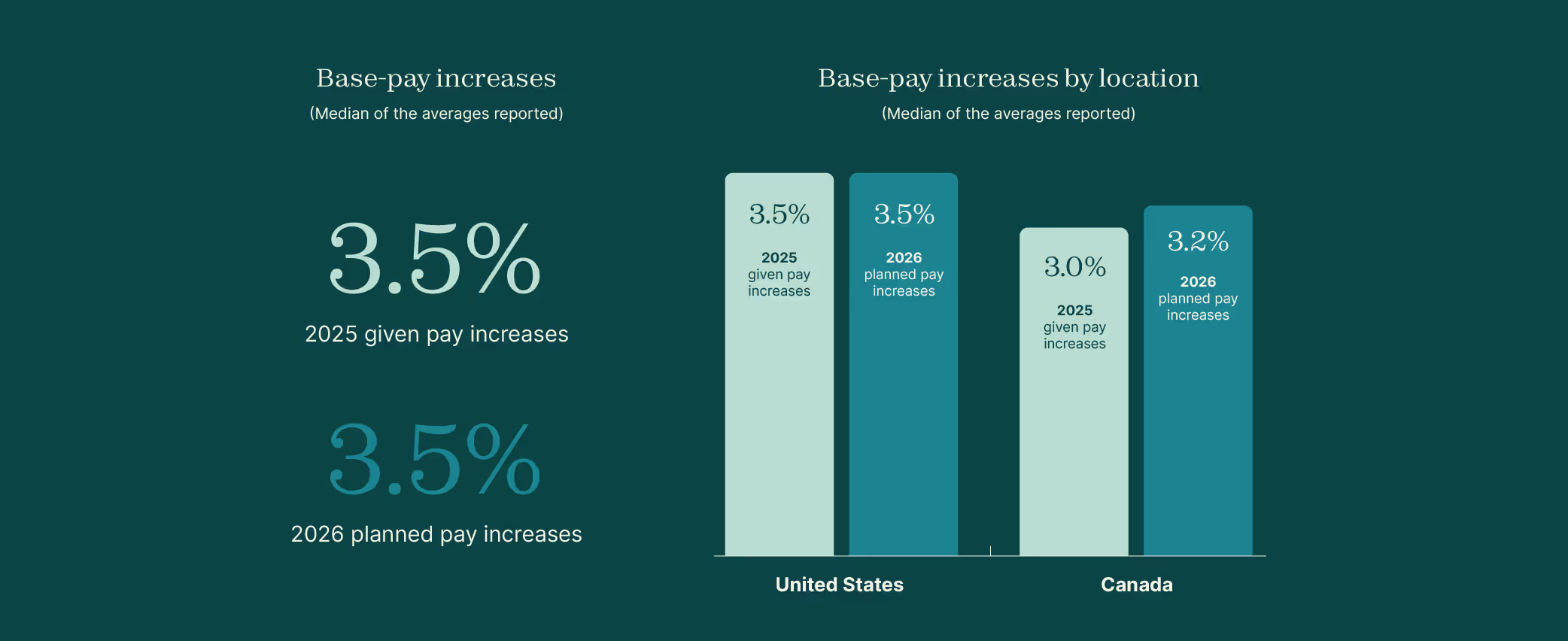
One of the most notable findings from the 2026 data is that median base-pay increases have not materially changed year-over-year:
- 2025 given base-pay increases: 3.5%
- 2026 planned base-pay increases: 3.5%
After years of rapid change driven by inflation spikes, talent shortages, and retention crises, organizations are deliberately avoiding overcorrection and trying to set a baseline for expectations around annual pay increases. Instead of increasing budgets, employers are focusing on precision, ensuring limited dollars are spent where they matter most.
For HR teams, this reinforces a critical best practice: confidence in pay decisions comes from data.
What is driving base pay increases
While global inflation dominates headlines, compensation decisions continue to be shaped primarily by the cost of labor, not the cost of living. That said, cost-of-living still influences annual increases as cost of labor is affected by the cost of living.
In 2026:
- 45% of organizations factor cost of living into pay decisions overall
- 43% in the United States
- 60% in Canada
Base-pay increases also continue to vary by location:
- United States: 3.5% for both 2025 given and 2026 planned
- Canada: 3.0% for 2025, rising slightly to 3.2% planned for 2026
Interestingly, while Canadian organizations are planning lower nominal increases, those increases are higher relative to inflation, which has stabilized faster and is near the Bank of Canada’s 2% target. In contrast, inflation remains elevated above targets in the U.S., roughly 2.7% by late 2025 rather than the target of 2%. Organizations in the U.S. also place a stronger emphasis on merit/performance when determining pay increases.
Across regions, merit/performance remain the most influential drivers of pay increases, cited by 76% of organizations. Market adjustments to remain competitive with the cost of labor follow closely at 46%.
Other common factors in pay increases include:
- Internal pay equity adjustments
- Competitive or in-demand skills
- Pay compression
- Education or certifications
- Minimum wage increases
- Tenure and employee location changes
While compensation strategies vary, effective compensation planning balances performance and internal equity with workforce realities.
The rise of “peanut butter” increases: myth vs. reality
One of the most talked-about trends for 2026 is the growing interest in across-the-board pay increases, often called “peanut butter increases.”
Myth: Peanut butter increases are not considered a best practice because performance no longer matters when everyone earns the same pay increase
Reality: Performance still matters, but not in the same way.
According to the data:
- 48% of organizations plan to continue performance-based increases
- 18% are considering peanut butter increases
- 16% are newly implementing them
- 9% already use this approach
- 8% are unsure
In total, over 40% of organizations are using or actively considering standardized pay increases in 2026. Among top-performing organizations — those exceeding revenue goals — that figure rises to 56%.
Rather than abandoning merit, many employers are simplifying differentiation, especially for large frontline or lower-wage populations where performance ratings can feel subjective, administratively burdensome, unmotivating, or misaligned with inflation’s uneven impact.
Performance can still be rewarded through bonuses, pay range progression, and promotions, which might feel more meaningful, better tied to actual achievements, and result in more substantial pay.
Frequently asked questions about pay increases in 2026
Are salary increases supposed to beat inflation?
Employees expect pay raises to exceed inflation, but in practice, salary increases are designed to reflect market movement and performance, not serve as cost-of-living adjustments. That said, when pay increases are below inflation, employees are effectively earning less than the year before. In 2026, many organizations are balancing inflation awareness with long-term pay sustainability.
If salary budgets are flat, how do we stay competitive?
Competitiveness comes from allocation, not size. Organizations that invest in accurate market data, proactively address pay compression, and communicate pay decisions clearly have higher confidence in their compensation planning.
Should we move away from performance ratings?
Not necessarily. While performance ratings have faced criticism for bias and complexity regarding pay increases, abandoning them entirely can create other challenges. Performance should still be measured, but many organizations are refining how performance ratings are used.
How important is communication around pay increases?
Pay communications are a critical component of compensation planning. Even well-designed pay programs can fail if employees don’t understand how decisions are made. Transparency, supported by credible market data, is one of the strongest drivers of trust and engagement.
Employer confidence in pay increases is on the rise
Compensation management is both an art and a science, but new forms of salary data are improving the practice. Despite ongoing uncertainty, 60% of employers believe their 2026 pay increases are competitive for retaining and engaging talent. Confidence is even higher among Payscale customers, with 70% reporting they are fairly or very confident in their pay increase planning.
This reinforces a key insight for HR leaders: confidence comes from clarity. When organizations understand how their pay compares to the market and can explain the “why” behind decisions, both leaders and employees feel more secure, even in a constrained budget environment.
What salary increase trends mean for HR in 2026
As compensation planning stabilizes, expectations for compensation leaders are rising. In 2026, success is less about reacting to external shocks and more about building durable, defensible pay strategies that use cutting-edge innovations to create both efficiencies and confidence in pay decisions.
Ultimately, the organizations that win in 2026 will be those that treat pay increases not as an annual transaction, but as part of a broader compensation narrative grounded in data, aligned with business goals, and communicated with transparency.
For more details on salary increase trends in 2026, download Payscale’s 2026 Pay Increase Preview Report for a breakout of pay increases by industry and company size and sign up for the 2026 Compensation Best Practices Report.