



The U.S. experienced almost no job growth in 2025, yet January 2026 job data should give HR pause.
First, the bad news for job seekers. Preliminary data from the Bureau of Labor Statistics (BLS) showed the economy added 584,000 jobs in 2025. That was already a far cry from the 1.46 million jobs created in 2024.
Downward revisions last month brought the 2025 jobs number to an anemic 181,000 (or around 15,000 per month). Excluding recessions, 2025 was the worst year for job growth since 2003.
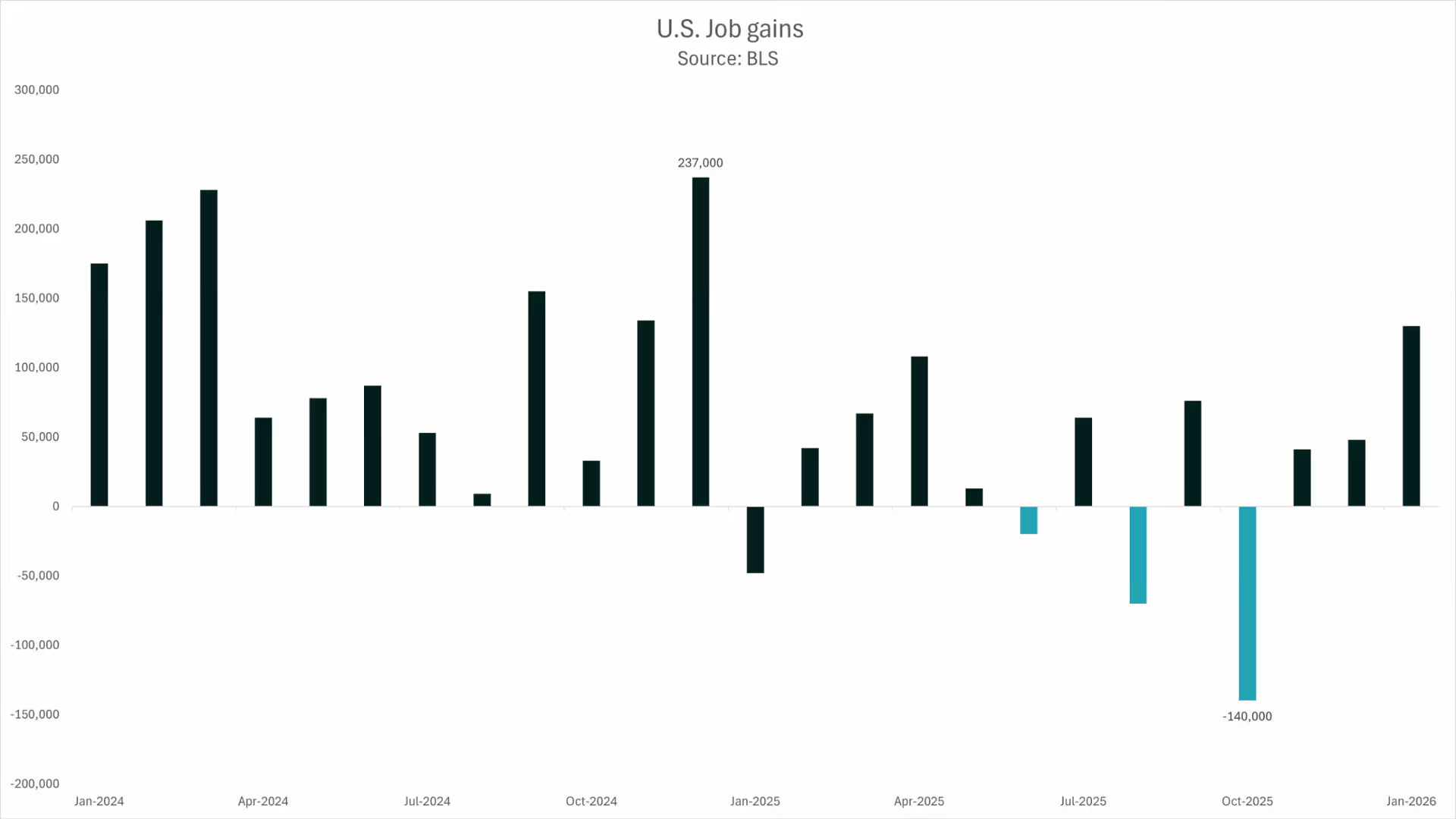
Yet the new year started with a bang. Economists predicted 55,000 jobs would be created in January 2026. The labor market defied expectations by adding 130,000.
Employers and HR are feeling the whiplash. Should they prepare for a hiring rebound? Should they refocus on retention? These questions loom as the labor market shows signs of life after a year of stagnation.
Despite its recent freeze, we are cautiously optimistic about the labor market in 2026.
Let’s discuss the reasons why.
Labor market projections 2026: the base case
Forecasters predict a steady 2026 economy. Despite significant headwinds, consensus opinion doesn’t see a recession. Goldman Sachs is most bullish, forecasting 2.8% GDP growth. Modest improvement, no cataclysmic failure.
If these projections hold, the labor market likely stays stalled. Hiring will remain slow, and unemployment may tick up a few decimals.
Under this scenario, HR should focus on:
Auditing talent. Know which roles are mission-critical and which are redundant. Lock down key talent and upskill employees to fill gaps.
Triaging hiring practices. Pause recruitment for roles that don’t move the needle and double down on high-impact hires.
Keeping up employee morale. Give employees growth opportunities and internal mobility. Neglect this and your top talent will walk the moment hiring rebounds.
Getting costs under control. Cut what doesn’t matter. Trim frivolous benefits and kill unnecessary spending such as travel (when possible).
Talking to your people (constantly). Tell employees what’s happening with the business and why you’re making these calls. Silence breeds paranoia and layoff anxiety. Transparency builds trust.
If macro is sluggish and hiring doesn’t thaw, every head requires more scrutiny. So, manage costs but keep your people engaged and talent franchise intact.
Now, let’s assume the opposite: January wasn’t a blip. Hiring picks up in 2026. 100,000+ job growth per month becomes the new norm.
It’s not far-fetched. The labor market has shrugged off predictions before. Most of our economic indicators have already betrayed us.
No one knows what the labor market will do this year.
Why you should also plan for a rebound in hiring
Companies are sitting on the sidelines, waiting in vain for the market to give them direction. A recent WaW survey captures the tension in workforce planning: 20% of employers plan to add headcount in 2026, while another 9% say they’ll cut.
Employers are focused on selective hiring, rather than broad expansion. However, this assumes the same low-hire, low-fire labor market of 2025. And this assumption about the labor market and macro might not hold.
What if the economy starts to expand? Planning for modest growth and hiring is one thing. Betting the farm on it is another.
Digging deeper in January’s job report reveals both business-as-usual and some (potentially meaningful) surprises:
- Health Care & Social Assistance continued its upward trajectory (124,000 jobs)
- Professional & Business Services showed unusual strength after a dismal 2025 (34,000 jobs)
- Construction was boosted by unseasonably warm weather (33,000 jobs)
- Manufacturing proved news of its death was greatly exaggerated (5,000 jobs)
- Financial Service slumped as insurance carriers experienced layoffs (-22,000 jobs)
- Federal Government kept losing employees (-34,000 jobs)
The labor market is far from firing on all cylinders. Much of the growth remains concentrated in Health Care & Social Assistance — the same trend that played out through 2025.
There are some bright pockets though.
Growth in Professional & Business Services and Manufacturing may indicate a labor market stabilizing at new heights, instead of one in free fall.
If hiring picks up and the economy expands, you don’t want to be caught flat-footed.
So prepare for a sudden surge in hiring as well.
Plan where you’ll need people most. Work with leadership to figure out your staffing needs for high-growth scenarios.
Build talent pipelines before you need them. Expand where you source talent and fix broken recruiting processes now. That way, you’re not scrambling if hiring heats up.
Look internally first. Check if other departments have talent sitting idle. Match them to open roles before investing in external hires.
Get your tech stack in order. Automate ATS systems and invest in compensation software to attract the right candidates. Manual processes simply won’t suffice if hiring velocity spikes.
Make onboarding scalable. You need onboarding that works whether you’re hiring 5 or 50 people.
Watch your competitors closely. Track your competitors' hiring habits and market shifts. If you wait until everyone else is adding headcount, you’re already behind.
Hiring may stay frozen or it may pick up. What won't change is your need for strong compensation data.
Compensation data for any market weather
Whether the labor market rebounds or stands still, quality pay data is the glue holding everything together.
Many HR teams can’t answer basic questions: Are we overspending on engineering talent? Is our sales comp competitive? Where should we invest?
Payscale offers compensation intelligence for informed hiring and workforce planning decisions. In a sluggish labor market, you’ll know where investments matter most. If hiring picks up, you’ll stay a step ahead.
We answer the following questions:
- Are you investing too much or too little in compensation? What’s your spend compared to the market? When budgets tighten, you need to track every comp dollar.
- Is your compensation competitive? How does your pay stack up against your peers? If hiring abruptly accelerates, can you attract talent? If it plods along, are you wasting budget?
- What’s your workforce health? How strong is your talent franchise? In uncertain times, tracking tenure and growth illuminates your strengths.
Market uncertainty demands agile compensation. Otherwise, you’re simply reacting to whatever it throws your way.
Imagine this: you understand where to cut costs without losing critical talent. You also understand where to invest if hiring accelerates. You stroll into budget meetings with CFO-level insights about your workforce and comp plans, meeting the labor market and macro environment as they're trending.
In volatile markets, guessing isn’t a sound strategy. You may not know where things are headed, but with Payscale you always make the right moves, whatever comes next.