



A 3.5% raise may sound small to employees. Until you add health care benefits, that 10% bonus, and 401k match.
Employees often only consider base pay, missing the full value of compensation packages.
With some employers seriously deliberating “peanut-butter” pay increases this year (across-the-board raises regardless of performance), total rewards statements (TRS) will become more critical.
While pay-for-performance (P4P) is still best practice, it’s subject to bias. Merit-based increases are also tougher to administer. It’s simpler to give everyone the same amount. And it might be fairer, too, with inflation taking a hefty bite out of EVERY workers’ paycheck.
The tough part: how do you explain this to high performers? They might feel cheated. Let rewards statements do the heavy lifting. Show them how much they’re actually earning — not just what shows up in online deposits.
Let’s start with a quick definition of total rewards statements before jumping into the how and why.
What is a total rewards statement?
A total rewards statement is comprehensive document showing employees the full value of their compensation package beyond base salary. It includes salary, bonuses, benefits, retirement contributions, paid time off (PTO), and additional perks. Typically, it’s sent to employees during or shortly after merit cycles to help them understand their complete compensation.
What’s in total rewards statements? We’re glad you asked. Stealing a template from Payscale’s Total Rewards Software, let’s take a look.
Download our Total Rewards Template.
Statement summary
First, we have a statement summary. It sets the stage. While cash makes up the biggest slice of total compensation, other monetary rewards deserve their day in the sun.
Compensation philosophy
Your compensation philosophy spells out your approach to pay. Do you value equity and transparency? How do you use market data?
Don’t make it too complicated. Employees won’t understand the difference between HR-reported and other salary sources. Brevity is your friend: “we target a competitive percentile of the market using multiple sources of validated and unbiased third-party salary data.”
That’s enough. If pressed by an employee, you can offer a deeper explanation.
Truthfully, most employees likely won’t even look at your compensation philosophy or statement summary.
Here’s a template you can use:
Total rewards example
87% of this compensation package is cash, but a hefty 8% goes toward health and wellness. We also see the total rewards value.
Cash compensation as total rewards (it’s more complicated than salary alone)
Cash makes up the biggest chunk of compensation packages — but even this isn’t always straightforward. Rewards statements include bonuses along with long- and short-time incentives.
Capture stuff like:
- Equity
- Sign-on bonuses
- Commissions
- Stock shares
You’ll see this employee earns $150k per year. But with a bonus of $10k and a mix of LTI and STI at $15k, they actually earns a total cash comp of $175k.
Retirement and savings
This employee is lucky enough to receive a pension, coming in at $2,500 per year. Additionally, they receive an employer match on their 401k. They contributed 3% last year, matched at 50%, giving them another $1,500.
Health and wellness
We NEED to talk about employee health benefits. Employees rarely think about the value of this benefit. Comprehensive health benefits have become so commonplace at larger companies that workers take them for granted.
If you spent Q4 in constant conversation with your benefits broker, you know better. Renewals were expected to grow by an already astronomical 9%, but some companies saw double digit increases.
Looking at the rewards statement below, factoring in health (including dental and vision), along with disability insurance, we add another $15,520k to this employee’s total compensation.
Additional benefits
And we keep tabulating. This employee’s company also offers tuition reimbursement, PTO, and other allowances. What are other allowances?
Could be anything and everything. From remote work stipends and childcare benefits to more exotic rewards like pet insurance, HR professionals are getting crafty designing total rewards programs to stand out in the market.
When we add up this employee’s total compensation, they don’t earn $150k but $201,920. That’s their total comp.
Why do companies use total rewards statements?
Employers send total rewards statements for the following reasons:
- Improves retention: Employees who know their total compensation (often 20-40% more than base salary alone) are less likely to leave.
- Increases perceived value: Most employees underestimate their total compensation by at least 20% (often more).
- Blunts impact of modest pay increases: A 2% raise appears much larger when employees know health care costs rose 9% (and their employer ate these costs).
- Builds trust: Transparent and clear documentation of all compensation builds trust and demonstrates a commitment to the entire employee.
What’s the difference between total rewards and total compensation?
Total rewards encompass everything an organization offers employees, including compensation, benefits, recognition, and career development. Total compensation is narrower, focusing only on the monetary value of salary, bonuses, and benefits. Total compensation is a subset of total rewards.
Total Compensation
- Base salary
- Bonuses and incentives
- Benefits (health, retirement)
- Additional perks with monetary value (PTO, tuition reimbursements, etc.)
Total rewards
- Base salary
- Bonuses and incentives
- Benefits
- Additional perks
- Work-life balance
- Career development
- Recognition programs
- Company culture (that foosball table you bought for the office counts)
- Flexible working arrangements
While total reward statements quantify monetary components, they’re most powerful when connected with your total rewards program .
The total rewards statement above becomes a necessary touchpoint that reinforces how compensation fits neatly within your Employee Value Prop (EVP) — connecting dollars to career growth, health benefits with mental wellness.
Creating a total rewards strategy
Current labor market woes don’t give you a pass on total rewards. In fact, your total rewards strategy is arguably more important now. Employers aren’t dealing with job hopping but job hugging.
Here’s the reality: your workforce has tuned out. Total rewards statements show employees you care about their wellbeing — even during tumultuous times.
Yet the use of total rewards statements dipped slightly in 2026. Only 43% of orgs provide a TRS with total compensation and benefits. Another 15% offer statements with cash compensation alone.
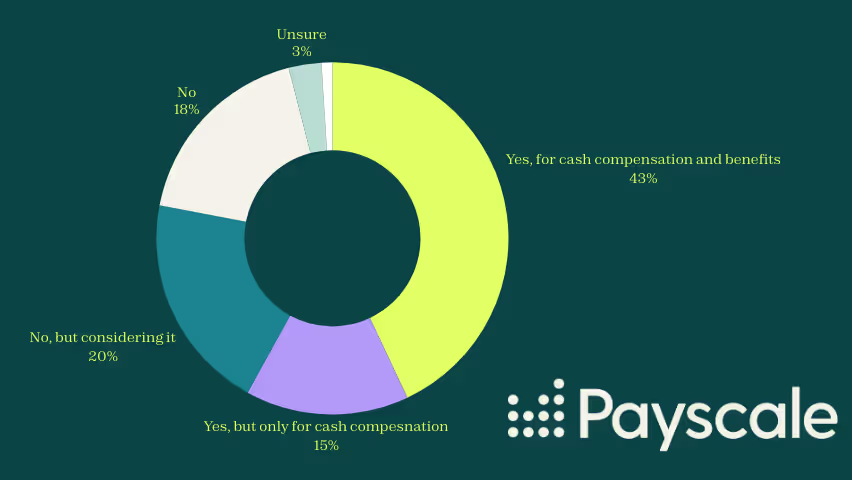
This is a mistake. Employers need to create a compelling EVP communicated through a TRS statement.
How do you create an enticing employee value prop?
- Start with discovery: Listen to your employees before you build. Their needs should shape your EVP, not your assumptions.
- Go beyond the paycheck: Expand your view of total rewards. Think about career development and the total employee experience.
- Decide where you want to standout: Connect your total rewards strategy to how you want to differentiate your employer brand.
- Make a splash: Use Total Rewards Statements to show employees the true value of their compensation.
Pay increase season: where good intentions meet hard realities
Pay increase season is brutal. You’re trying to reward performance, balance equity, and manage an increasingly tight budget.
It rarely works out cleanly.
High performers expect more. They know their contribution and want a raise that reflects. A 4% raise feels like an insult when they delivered 30% above target.
Budget constraints force tough choices. You can’t give everyone what they deserve. Some employees will be disappointed.
Inflation complicates everything. Cost-of-living increases chomp into merit increases. Employees see raises vanish when rent goes up 4% and groceries cost more every week.
Equity creates tension. You’re also trying to close pay gaps and address compression. That means some people get higher adjustments than others — explaining why is difficult.
Peanut-butter pay increases are tempting: Spreading merit increases evenly for everyone sounds like a good idea in practice. But it can tromp on motivation for top performers and “reward” mediocrity.
This is where total rewards statements earn their keep. When increases fall short of expectations, show employees the complete picture of their pay. That “modest” 2.5% increase looks different alongside a 15K health insurance contribution.
You can’t always give bigger pay bumps. But you can let employees know what they’re actually earning.
Why Payscale for Total Rewards Statements
HR teams can cobble together total rewards statements with manual processes. But it often results in errors and hours wasted on a process that should take minutes.
Payscale eliminates the Total Rewards tedium.
TRS built for scale and designed for flexibility
Payscale’s Total Rewards Statements let you create personalized statements in bulk. No manual updates required — just customizable templates for your organization.
Upload benefits data once. Update thousands of statements instantly. It's that simple.
Secure delivery and confident pay conversations
Share statements with encrypted email of download PDFs to drop on employee’s desks. Historical statements live on Payscale’s platform, so you’re not digging through old files when employees have questions.
And when managers need to explain comp decisions? They have the insights and context to have truly productive pay conversations.
Transparency that builds trust
With Payscale, employees see their full compensation in one clean professional statement.
When employees understand their total comp, retention improves. Trust grows. And pay communications work to your advantage.
Pay communications just got easy peasy.