


Organizations have historically treated payroll as a cost to manage rather than a business driver. But the ones getting it right – connecting spend on employee salaries to business results – prove that compensation is strategic and HR deserves a seat at the table.
The question at the center of the conversation: “Are we paying the right people the right amount to drive the outcomes we need — and can we prove it?” — Lexi Clarke, CPO of Payscale.
Proving it is where most companies trip up. Lots of teams think they're paying people right, but fewer can generate the charts to demonstrate the impact. That is where ROI actually lives
According to new research, organizations with a more strategic approach to compensation are realizing an estimated $1 million in annual value, driven mainly by retention and time reclaimed from manual work.
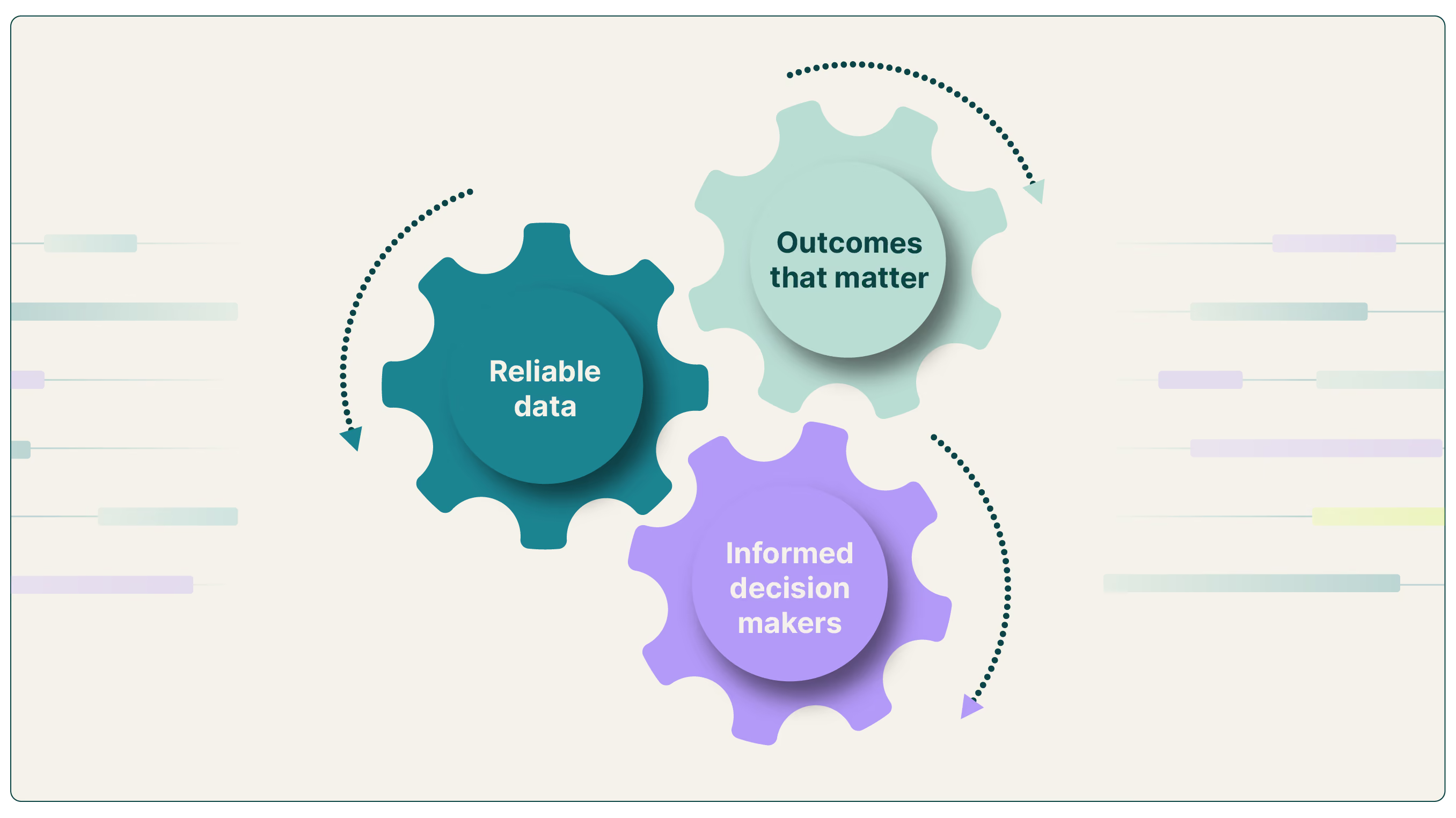
So, how do you get there? When you redefine it, ROI for compensation comes down to three things: reliable data, outcomes that matter, and informed decision-makers who know what to do with both.
Reliable data: trusted salary data in one system for connected analysis
You can’t drive ROI if your compensation decisions are built on stale data. Traditional compensation surveys are often behind the market by a year or more, so you’re making today’s calls based on yesterday’s reality.
That gap showed up clearly in how organizations sourced pay data before adopting a more centralized approach. In our research, we surveyed 60 enterprise customers and found that 55% leaned on third-party salary surveys and 18% relied on internal salary history. In addition, 63% were dealing with cumbersome spreadsheets, and nearly half ran into technical issues that quietly chipped away at trust in their own numbers.
Data must be accurate, fresh, accessible, governed, and capable of answering real questions. Compensation teams think in terms of market benchmarks and pay progression — are employees paid fairly for the work they do? Finance teams think in terms of total payroll budgets and controlling costs. To justify spend, compensation teams need to be able to present numbers to leadership that are rooted in trusted data and can stand up to inquiry.
Payscale Intelligence Cloud with Peer — Payscale’s data ecosystem — solves this problem. Validated by a team of experts and continuously refreshed, Peer pulls fresh benchmarking data straight from HRIS systems. Layered with third-party salary surveys within your companion benchmarking software, you get a single source of truth system you can stand behind.
It’s this system — where surveys, internal data, and Peer interact and connect — that replaces the fragmented approach most teams spend time piecing together.
Outcomes that matter: Connect every dollar spent on a business result
Reliable data is the starting point. ROI emerges when you connect data to business outcomes that matter — retaining top talent, avoiding costly turnover, and fill vacant roles to prevent loss of productivity.
The numbers back this up. In our research, twice as many organizations (60%) proactively flagged pay-related flight risks using Payscale compensation software compared to those that didn’t (30%). That earlier visibility translates into an estimated 13 additional employees retained per year, worth roughly $832,000 annually once you factor in replacement costs. And once offers were more grounded in current market data, acceptance rates improved by 10%.
In other words, instead of citing a number in isolation, build a story around what it means for the business. A number on its own won’t move your CFO. But a story like, ‘We invested here because this person is critical to hitting our revenue goals, and losing them could set us back months’ gives Finance something concrete to understand, evaluate, and act on.
You can also call out trade-offs. For example, if your compensation team saves an estimated 30.5 hours a week using compensation software, that time can be redirected toward new projects or higher-value strategic work. Most teams put that time back into new projects or higher-value work.
What you need to prove is whether your investment actually changes outcomes. It’s just as important to track when your compensation strategy flops as when it works. Look for evidence on both sides: if targeted pay increases help retain critical talent, that’s a win; if you spend more and attrition stays flat, that’s a miss.
Informed decision-makers: Communicate pay decisions with confidence
Here’s what most people miss: compensation isn’t just HR’s problem. It lives where talent strategy meets financial performance, and it only works when HR, finance and people managers are talking to each other.
Confidence is a big part of the equation. From our research, only 38% of respondents felt “mostly” or “very” confident presenting comp recommendations to their board before using Payscale. After using Payscale, that number climbed to 94%. The same pattern appeared in how decisions get communicated more broadly: 86% said their organization got better at clearly explaining pay decisions to employees and 58% said managers felt more confident having those conversations in the first place.
That doesn't mean everyone is always on the same page. Some of the best comp conversations happen when there's healthy tension. What matters is transparency and being able to communicate pay decisions with confidence, which boosts employee understanding of their compensation.
Improved transparency reduces turnover and helps teams identify flight risks. On the hiring side, organizations report a 10% improvement in offer acceptance rates after adopting tools that enable confident pay conversations. When candidates understand the offer, they accept more often.
Let’s summarize
ROI in compensation is built on three things: data you trust, outcomes you can see, and people understanding the story.
The organizations pulling ahead aren’t the ones with the biggest comp budgets. They’re the ones who know where their investment is creating value and how to prove it.
The ROI of strategic compensation shows how investment in Payscale delivers the outcomes that matter most, from retaining critical talent to protecting revenue.