

Salary increases to rise in 2027
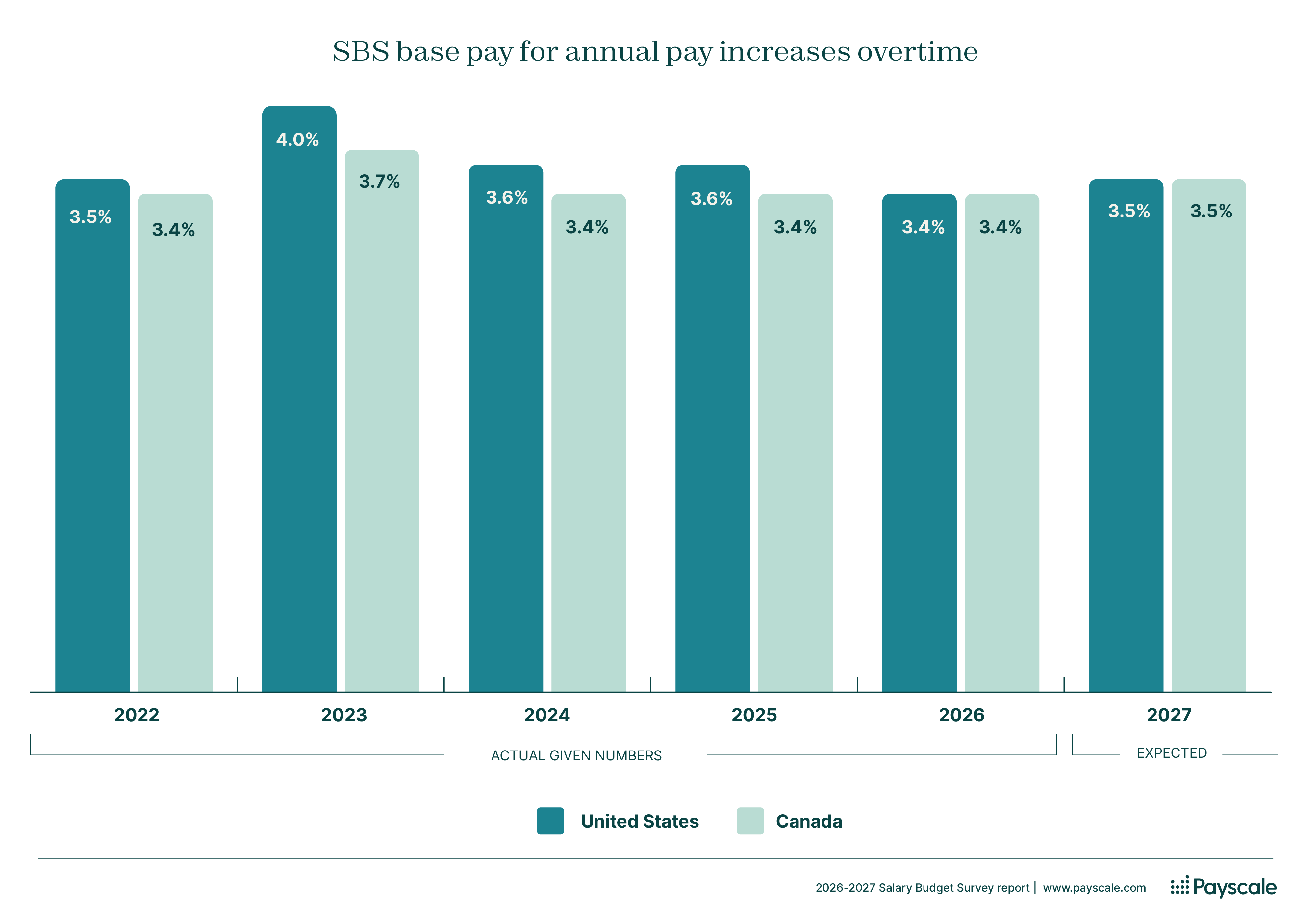
United States employers plan on 3.5% salary increases for 2027 on average. This is 0.1% higher than what employers say they actually gave for pay increases in 2026. Compared to last year’s report, United States employers gave lower pay increases in 2026 (3.4%) than they predicted they would give when asked in 2025 (3.5%).
We also calculated the median for total pay increases given in 2026 and planned in 2027. In 2026, the median actual pay increase given was 3.4% for the United States. For 2027, the median pay increase is planned to be 3.5%.
For clarity surrounding salary budget planning, we also asked explicitly: “What is the 2027 total payroll increase budget for the upcoming year, expressed as a percentage of your current total payroll?” For the United States, salary budgets in 2027 average at 3.5%.
In Canada, 2026 pay increases were 3.4% and 2027 pay increases are planned to be 3.5% on average. A detailed breakdown for pay increases in Canada is included in the full report.

Salary increases were trending down
While planned pay increases for 2027 are higher than 2026, salary increases have been trending downward since COVID-19 and the Great Resignation. In prior years, inflation hovered around 2%, with pay increases in the United States being around 3% on average. After COVID-19, inflation spiked and so did turnover, leading pay increases to also increase.
While pay increases are not directly determined by cost of living, cost of labor is impacted as rising costs motivate employees to job hunt. As part of their retention strategy, many employers give pay raises above inflation.
In Canada, pay increases fluctuated between 2.5% and 3% before the pandemic. In 2027, Canada is set to be equal to the United States in pay increases, which is unusual.
Overall wage growth vs. inflation
Pay increases alone do not determine wage growth. Wage growth is also influenced by workers changing jobs and incurring higher wages due to market dynamics. Workers may also receive salary adjustments separate from annual pay increases. This is why it is important for employers to think in terms of total payroll budgets.
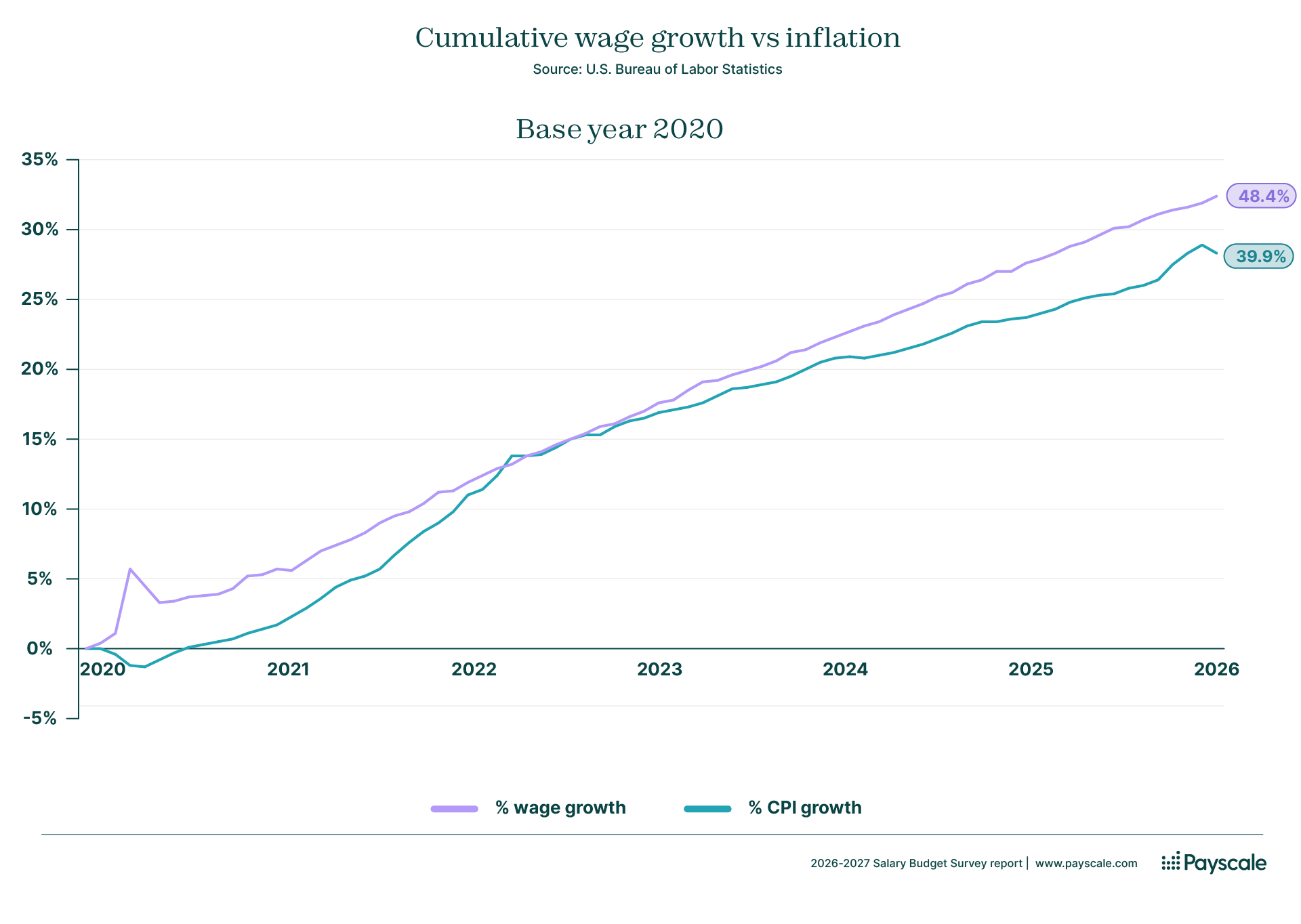
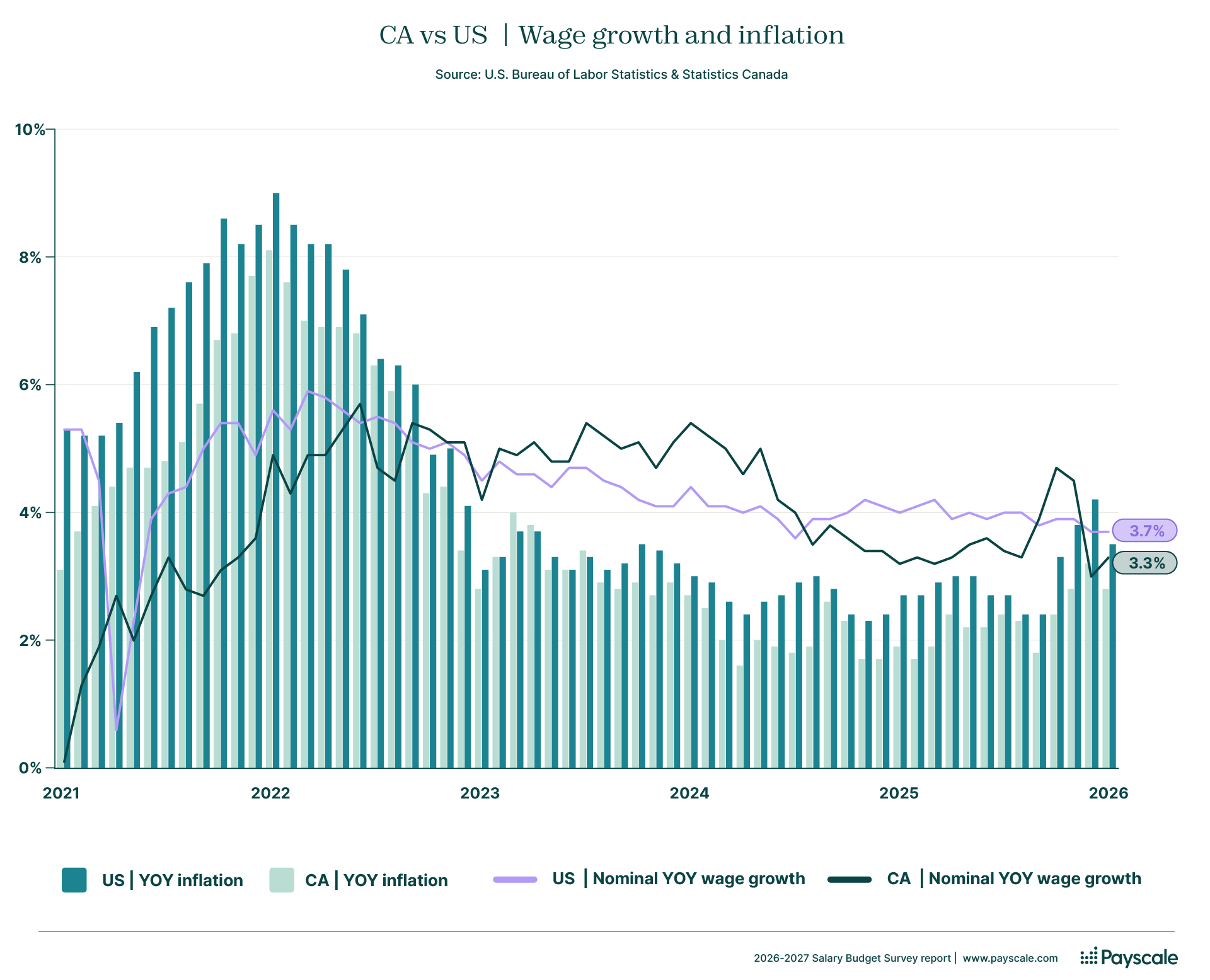
Below, we show wage growth over time sourced from the Bureau of Labor Statistics (CES) alongside YOY inflation. Nominal wage growth is not adjusted for inflation. Real wage growth is adjusted for inflation.
Inflation outstripped wage growth considerably during 2022-2023 because of the market effects of the COVID-19 pandemic but then fell below wage growth subsequently. Because inflation now matches wage growth, we are entering a period where workers may be more open to exploring the market to find a new job with higher pay.

Wages lose purchasing power as inflation increases. For employees, when pay increases do not exceed inflation, it effectively feels like a pay cut. However, inflation is also volatile, so it is important to take a long-term view. Whether wage growth exceeds inflation cumulatively depends on when you start counting. From 2020, cumulative wage growth exceeds inflation, with the exception of a period during the Great Resignation. When we look at wage growth vs. inflation for both the U.S. and Canada more granularly, we can see how wage growth was outstripped by inflation during the Great Resignation but has remained above inflation for the last few years. However, with inflation on the rise, the situation is now precarious.
The different types of pay increases
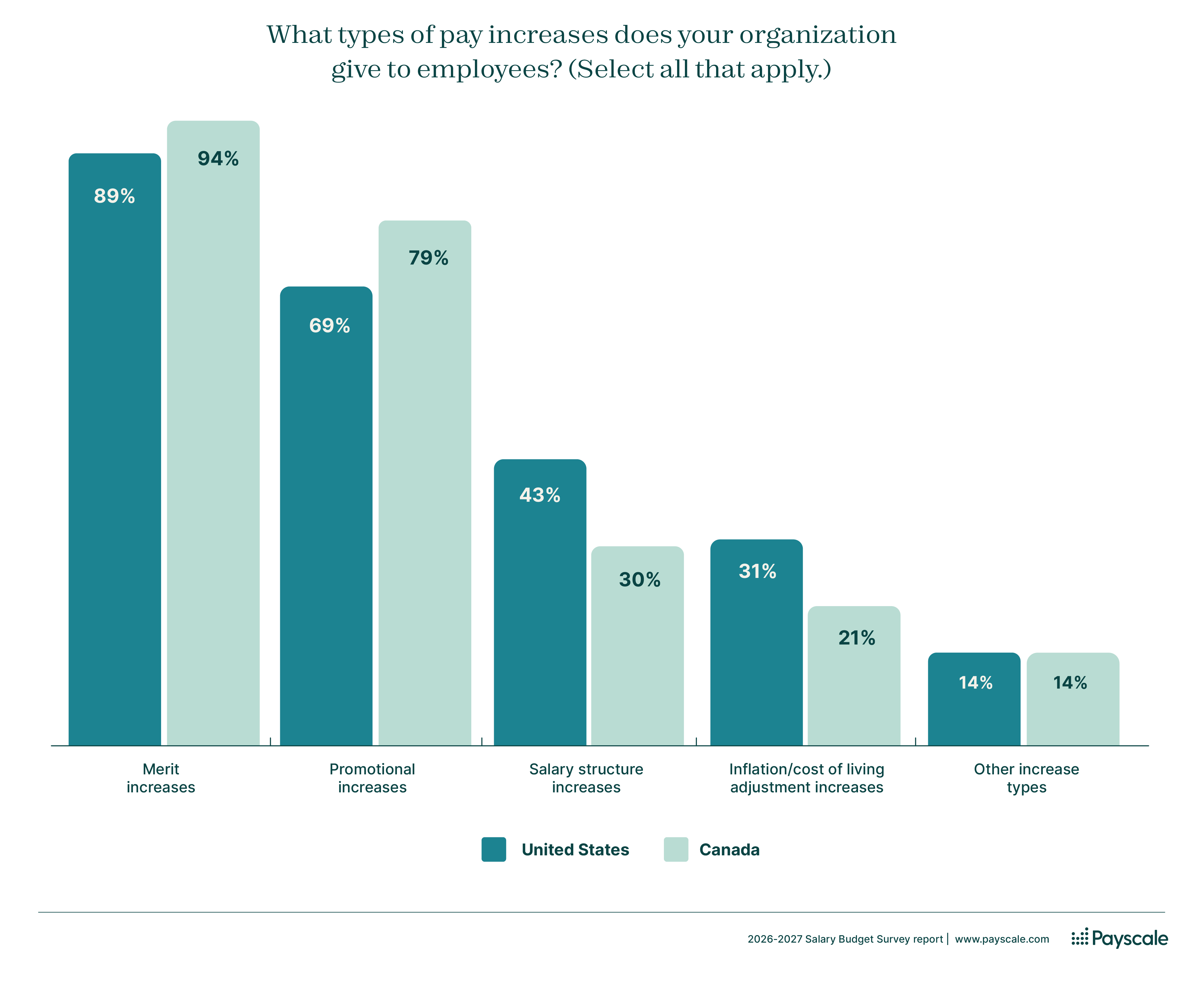
In our Salary Budget Survey, we ask about the different types of pay increases as not all organizations follow the same strategy or give pay increases for the same reasons. For base-pay increases, we ask about merit increases, cost of living increases (inflation), other types of increases, and total increases, which are self-reported. We also ask for promotional increases and salary structure increases.
- COLA increases: Cost-of-living pay increases that are granted to all eligible employees to keep up with inflation.
- Merit increases: Pay increases granted based on individual employee performance.
- Other increases: Any other pay increase granted during the course of the year, such as for pay equity or market adjustments.
- Total increases: The sum of pay increases granted over the course of the year. This is self-reported by respondents and not a calculation.
- Salary structure increases: Pay increases made to salary structure control points to align structures with current market rates.
- Promotional increases: Pay increases given to promoted employees.
In 2026, merit increases remain the most popular pay increase type. Some organizations choose to give multiple types of pay increases or different types depending on the job in alignment with their compensation and talent strategy.
Peanut butter pay strategy
Payscale’s 2026 Compensation Best Practices Report found that 44% of organizations were giving or considering across-the-board pay increases (known as peanut butter pay increases) in 2026 — 18% considering, 16% newly planning it, and 9% already using it.
In this year’s Salary Budget Survey (SBS) we asked this question again and found that 36% of organizations in the United States say they did in fact give across-the-board pay increases in 2026. For 2027, the percentage of organizations that say they are giving standard across-the-board pay increases drops to 32%.
Across-the-board pay increases are more common for organizations managing large workforces with hourly employees as well as industries with step structures like Government and Education.

Peanut butter pay can be demotivating to employees as everyone receives the same increase regardless of performance. We asked whether organizations felt they were losing talent in 2026 due to insufficient pay increases and a quarter (25%) said yes.

Interestingly, only 17% of organizations in Canada say they gave peanut butter pay increases in 2026 and only 13% plan to do so in 2027. Correspondingly, only 15% of Canadian organizations say they are losing talent due to insufficient pay increases.
It should be noted that some organizations may combine across-the-board pay increases with other types of pay increases. For example, they may give a flat pay increase for all hourly employees for inflation and add merit increases and other types on top.
While not typically what is understood by “peanut butter pay,” delineating the different types can be an effective strategy for organizations with workforces more heavily impacted by cost of living, provided they also reward performance and the reasoning is clearly communicated.
While the average salary budget expressed as a percentage of payroll is 3.5%, we asked how that budget was allocated across different types. Here we find the lion’s share going to merit increases to reward performance, but with other types of increases also represented.

To learn how Payscale can help you navigate pay increase cycles, explore Compensation Planning, and ask for a demo.
United States: What is driving salary budget changes for 2027
In the United States, the percent of organizations anticipating a salary budget higher than last year is 30% — a substantial improvement over last year when it was only 16%. A majority of organizations (63%) expect salary budgets to remain the same (compared to 68% last year). Only a small portion (8%) expect budgets to be lower (compared to 16% last year).

The primary reason organizations in the United States said they plan on a larger budget for pay increases is that economic conditions have improved (30%). Last year, the leading reason was a change in compensation philosophy of competitive positioning, which was 35% last year but only 24% this year.
Organizations that are planning to give lower pay increases cite concern about future economic conditions or business performance (42%), which is substantial but much lower than last year when it was 66%. Prior year increases being higher than usual also dropped as a reason from 32% to 22%.

United States: what are salary budgets by industry for 2026-2027?
We segment our Salary Budget Survey data by industry. In the United States, we see the largest gains in Business Services and Nonprofits and the greatest declines in Aerospace & Defense and Media, Sports, & Entertainment.
Note: Industry cuts are derived. Counts must number at least five participants for data to be included. Especially high pay increases from one participant can skew averages.
Salary increases around the world
In our survey, we also ask for salary increases for employees in select other countries where respondents manage pay.
Pay increases are expected to be higher in countries like India where inflation is projected to be 9%. While inflation has dropped below 3% in some countries (China, Finland, France, Germany, Japan, Singapore, UK), it is notable that wages are projected above 3% everywhere but Finland.
Methodology
Payscale clients and contacts were invited to participate in our Salary Budget Survey (SBS) in May-June 2026. Submissions were accepted through June 12, 2026, resulting in 1,266 usable submissions.
Respondents were asked to submit data for the United States, Canada, and select international locations for the following employee groups:
- All employees
- Non-exempt employees
- Exempt (non-management) employees
- Managers
- Officers & executives

Respondents were instructed to enter no response for increase programs that do not exist in or were not applicable to their organization, and to enter a response of “0%” for programs that exist but were budgeted to receive no increase for the year in question. “0%” responses were included in the calculations for the figures reported here.
Note that a minimum of five responding organizations were required to publish each of the above statistics. Only one response per organization was used for analysis.
Respondents were asked to self-identify into a pre-defined industry, company type, and size classifications.
Statistics for the following increase programs were collected as an average across all respondents for a given data cut. The data for these programs are entirely self-reported:
- Inflation/cost of living increases: Base-pay increases that are granted to employees, typically in an “across-the-board” manner, to account for inflation. Respondents were asked:
As a percentage of base-pay, what is/will be the typical Inflation/COLA increase in [year] for [employee type]?
- Merit increases: Base-pay increases granted based on individual employee performance. Respondents were asked:
As a percentage of base-pay, what is/will be the typical Merit increase in [year] for [employee type]?
- Other increases: Any other base-pay increase granted during the course of the year (for example, equity or market adjustments). Respondents were asked:
As a percentage of base-pay, what is/will be the typical Other increase in [year] for [employee type]?
- Total increases: The sum of base-pay increases granted over the course of the year. This is self-reported by respondents and not a calculation derived from the other increase programs. Not all organizations offer all types of increases. As a result, Total increases reported may not equal the sum of Cost of Living, Merit, and Other increases reported. Respondents were asked:
As a percentage of base-pay, what is/will be the typical Total increase in [year] for [employee type]?
- Salary structure increases: Increases made to salary structure control points in order to align structures with current market rates. Respondents were asked:
What is/will be the typical salary structure increase in [year] for [employee type]?
- Promotional increases: Pay increases given to employees who have been promoted. Respondents were asked:
As a percentage of base-pay, what is/will be the typical promotional increase given to promoted employees in [date]?
Payscale is the pioneer of compensation intelligence, helping organizations make smarter pay decisions that drive business performance. For more than 20 years, Payscale has combined trusted market data with AI-powered technology to deliver actionable insights that turn pay from a cost into a catalyst for growth. The Payscale Intelligence Cloud portfolio of solutions — Ascent, JobNav, and Paycycle — empower top companies and businesses like Cintas, Leidos, Chipotle, Ohio State University, and TJX Companies.
Create confidence in your compensation. Payscale.
To learn more, visit www.payscale.com.
Download the report
The full report provides segmentation of salary increases and salary structure adjustments by different types of employees broken out by industry, revenue, organization size, organization type, region, and state or province for the United States and Canada. It also contains salary budget trends, promotional increases for the previous year, and planned salary structure increases.

Get notified to participate next year
Sign up to participate in the 2026-2027 Salary Budget Survey.
Clear, confident pay decisions await
Experience Payscale for yourself.