


Compensation intelligence — the idea that pay decisions should be continuous, distributed, and defensible across an entire organization — has shifted quickly from an emerging concept to a competitive necessity.
We covered the broad contours of this shift in our recap of WorldatWork Total Rewards 2026, where it emerged as one of the defining themes of the conference. But one session deserves a closer look.
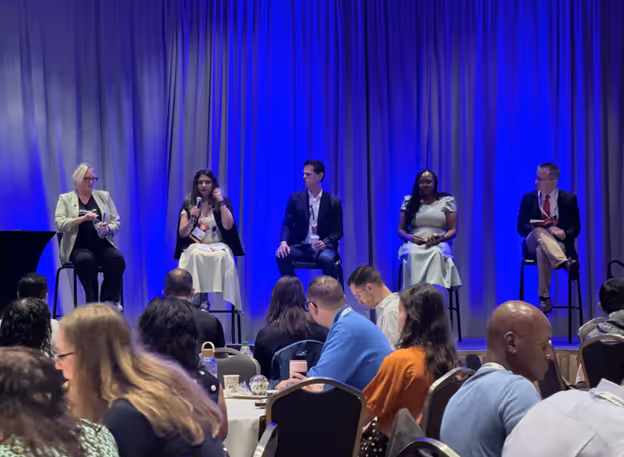
On Tuesday morning, April 21, Payscale hosted a sponsored Breakfast Briefing at WorldatWork Total Rewards 2026 in San Antonio. The session titled "From Siloes to Strategy: Connecting Compensation Across the Business" packed sixty minutes with something that conference sessions rarely deliver: an honest, sometimes uncomfortable conversation about pay told from four completely different vantage points.
Everyone involved in pay is solving a different problem
The session was moderated by Ruth Thomas, Payscale's Chief Compensation Strategist and the host of Payscale’s Comp and Coffee podcast. The session opened with Ruth introducing a framework that set the tone for everything that followed: in most organizations, pay decisions don't belong to one team. They touch HR, finance, people managers, and employees — each of whom brings an entirely different set of questions, pressures, and definitions to the table.
To make that tension visible, Ruth introduced four compensation practitioners who adopted four different personas in the organization.
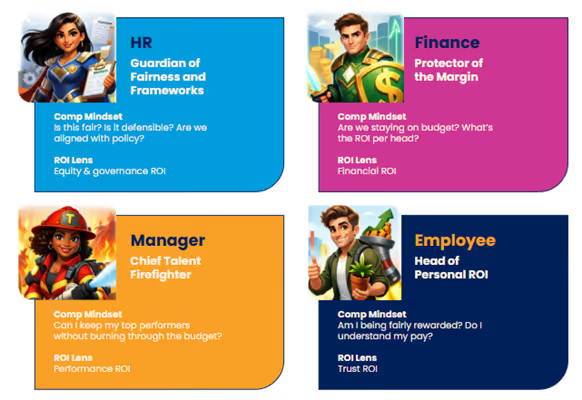
Each persona carries a distinct compensation mindset and measures success differently.
- HR asks: Is this fair? Is it defensible? Are we aligned on policy?
- Finance asks: Are we staying on budget? What's the ROI per head?
- Managers wonder: Can I keep my people without burning through the budget?
- Employees think to themselves: Am I being fairly rewarded?
What makes these personas more than a thought exercise is that they're all present in the same pay decision — just never in the same room and never working from the same data.
Differing perspectives on compensation
Four practitioners joined Ruth to bring these personas to life — each speaking from their own professional experience, not a script.
Rajashree Campbell, Head of Compensation at Memorial Sloan Kettering Cancer Center, represented the HR perspective: the Guardian of Fairness and Frameworks.
In healthcare, the stakes of getting compensation wrong aren't just talent retention — they're gaps in patient care.
Raj's framing of the problem was precise: "We don't have a compensation problem. We have a data trust problem."
Philip Watson, CFO at Payscale, played the Finance role: the Protector of the Margin.
Philip's most important contribution wasn't a defense of the budget — it was an admission of what the financial perspective misses. When three physicians left Memorial Sloan Kettering in a single quarter, all with compensation records showing they were "in band,"
Philip described the wake-up moment: the cost of replacing those doctors far exceeded what a proactive market adjustment would have cost. Framing compensation as cost control, he observed, might actually be the more expensive option.
Illisa May, VP of Performance, Rewards, and Talent Insights at Corpay, brought the manager lens: the Chief Talent Firefighter.
Illisa was candid about the impossible position managers are often put in — handed a comp philosophy they don't fully understand, a limited budget to allocate, and an employee sitting across from them who has already done the research.
As Illisa put it: managers are responding to conversations that have already started.
Daniel Mealo, Manager of Compensation Data at Orlando Health, represented the employee perspective, and delivered the session's most visceral moment.
Three days before his annual review, Daniel was on LinkedIn. A hospital forty minutes away had posted his same role with a starting salary 12% higher. When his manager offered him a 3.5% increase, what Daniel heard wasn't the number. He heard: We know what the market looks like, and we've decided you're worth less.
His takeaway reframed the entire conversation: "The fix isn't a bigger number. The solution is a better conversation — one where my manager can say, 'here's where you sit in the band, here's why, and here's what changes that.' That conversation requires real-time data and the confidence to use it."
The problem is fragmented data
What the panelists' stories had in common wasn't bad intentions, inadequate budgets, or poor managers. The problem they were each describing — from four completely different angles — was the same one.
The data and workflows supporting pay decisions are fragmented. HR has survey data. Finance has payroll. Managers have a merit spreadsheet. Employees have Glassdoor. No one is working from the same foundation, which means the conversation about pay rarely produces shared understanding. It produces friction.
Ruth Thomas drew an analogy that landed: most organizations still run compensation the way hospitals once ran on paper charts. Each team — HR, finance, talent acquisition, people managers — is working from different data, different tools, and different assumptions. The result isn't just inefficiency. It's a trust problem. When the CFO and the head of compensation walk into the same budget meeting with two different datasets, the conversation becomes about whose numbers are right instead of what to do about them.
According to Payscale's 2026 Compensation Best Practices Report, 40% of organizations say misinformation or unverified data contributes to employees perceiving their pay as unfair. That perception has real consequences — in recruiting, in retention, and in conversations with real employees about their real salaries.
What Payscale Intelligence Cloud does about this
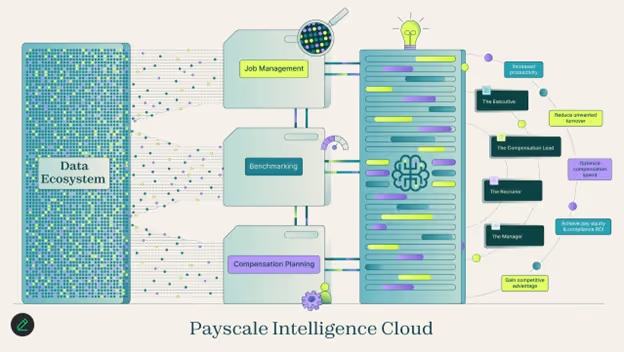
Payscale Intelligence Cloud is built to solve this structural problem. It's not a single tool or a feature upgrade — it's an ecosystem designed to put the right data in front of the right person at the right moment, across every role that touches pay.
It's built on four interconnected pillars:
A unified experience connects every stakeholder — from the comp analyst pricing a job to the executive reviewing workforce spend — through shared data on a single platform. When everyone works from the same playbook, decisions happen faster and earn broader trust.
Integrated data combines HRIS salary data, market signals, skills premiums, and labor demand into one continuously refreshed foundation. When HR, finance, and talent acquisition are drawing from the same source, the conversation shifts from "which number is right?" to "what should we do about it?"
Scalable solutions cover every stage of the compensation journey: job management, market benchmarking, compensation planning and the merit cycle, pay equity monitoring, and executive workforce intelligence. The same ecosystem serves an organization building its first pay structures and one running continuous market reviews.
Contextual intelligence delivers the right insight when it's needed. For a recruiter, that's a validated pay range when a requisition opens. For a manager, it's guidance embedded directly in the merit increase workflow. For a CHRO, it's workforce performance data contextualized against market peers before walking into a board meeting.
The shift Payscale Intelligence Cloud enables isn't just operational — it's strategic. Compensation stops being a bottleneck and becomes what it was always meant to be: a signal to every person in the organization about what the company values and how it invests in its people.
As Daniel put it in the session's closing moments: "Transparency without explanation isn't a feature — it's a liability. The employee doesn't need to see the data. They need to understand the story the data is telling."
That's exactly what compensation intelligence makes possible.