



Pay decisions depend on various factors, including benchmarking, range placement, pay equity analysis, and pay-transparent job postings, and all of this, in turn, depends on an accurate description of what the role does.
No pay model can be more accurate than the job information underneath it. Today, compensation decisions are made throughout the year, so the question is whether your job description keeps up.
Jobs change faster than job profiles
Jobs have always drifted: a reorg moves work between teams, a role stays open for six months while someone else takes on the work, a manager gives a high performer a project that becomes a permanent part of the job, and so on.
The pace of change, though, is new. Consider this piece of data: Payscale’s AI Workforce Impact Report found that 61% of employers are rewriting job descriptions because of artificial intelligence (AI) — and 49% say their salary structures haven’t kept pace, while 48% say their market benchmarking no longer reflects the skills many roles now require.
And while rewriting job descriptions isn’t hard, the questions that come next aren’t exactly a walk in the park:
- Who approved the change?
- Does the new version live in the human resources information system (HRIS), or in a Word file on someone’s desktop?
- Did it reach the profile your compensation team prices against?
- Will the next requisition for that role use the same version?
For many organizations, the answer is “we’re not sure.” Job content is scattered across SharePoint folders, email threads, and tools that sync with the HRIS on a batch schedule, if they sync at all. The result is two versions of the same job and no reliable way to know which one a decision was based on.
Why the job is the basic unit of pay
Every pay decision rests on the job:
- Benchmarking matches a role to market data based on what the role does.
- Range placement depends on the job’s family and level.
- Pay equity analysis compares people doing substantially similar work.
- Pay-transparent job postings need a profile you can stand behind publicly.
If the job record is wrong, the pricing is too, even with current market data and a solid salary structure. And if you defined the job two years ago, you may be pricing a role that no longer exists.
What a year of job decisions looks like
Jobs don’t change on a schedule, but the ongoing decisions that rely on them come up every quarter. Let’s take a look:
Q1: A reorg merges two teams. Two managers each had their own version of an operations analyst role. Before anyone’s pay changes, we need to consolidate, relevel, and reprice those roles. Which version is the real one?
Q2: AI transforms the support function. Take the specialist who used to spend most of their time answering tickets; now, they're in a position to oversee automated workflows and handle the escalations AI can't. Is it still the same job? Should it be priced the same?
Q3: An employee asks why one of their peers is being paid more. Two people in very similar roles are being paid differently. The 'why' depends on whether the jobs were ever comparable in the first place and whether you can demonstrate the differences.
Q4: The market data refresh comes through. Before you go and price anything at all, make sure that the jobs you're pricing are still the jobs that people are actually doing.
None of these waits for an annual review; each one needs a current, approved version of the job the moment the question comes up.
How always-on job management works
Always-on job management means that when a job changes, the change is easy to capture, consistent across the organization, and traceable later.
That’s what Payscale JobNav does. Your HRIS stores job profiles, and JobNav governs them.
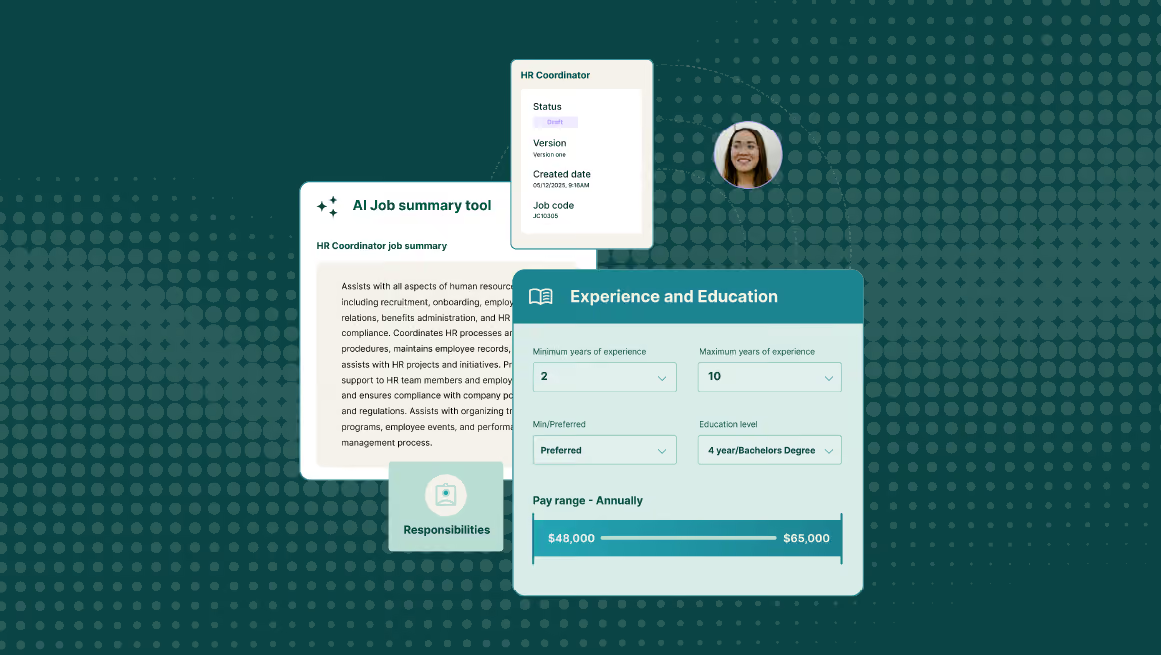
- One shared profile. JobNav maintains one governed profile for each job — including the title, summary, job family, level, Fair Labor Standards Act (FLSA) status, and full description. It syncs to your HRIS rather than replacing it, so you don’t need a second system to reconcile. Compensation, HR business partners, hiring managers, and recruiters all work from the same version.
- A visible change trail. Every edit is versioned so you can see what's changed, who's changed it, and when. Approval workflows keep the right people in the loop, and employee acknowledgments record who approved which version.
- Changes that flow through. Approved changes sync with your HRIS. Now nothing sits in a document waiting to be copied — the profile owns its fields, edited in one place so they can’t drift elsewhere.
- Version-aware connections. Only published, approved profiles reach your pricing workflows. Drafts and archived versions stay out. When a compensation analyst prices a role in Payscale Ascent, they can see where the job content came from and when it was last updated.
- Consistency across job families. Leveling templates set shared content and guidance for each level in a job family, which is the core of job architecture. When a template changes, JobNav flags every profile it affects, with updates landing across the family at once.
One job, every decision connected
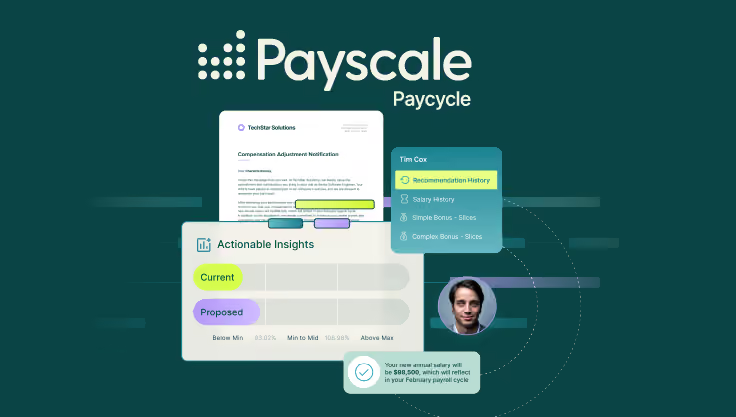
JobNav, a part of the Payscale Intelligence Cloud, is the job record that the rest of the platform is built on. Payscale Ascent prices it, Payscale Paycycle plans with it, and JobNav Recruiter turns it into job posts. One approved version of the job underpins every decision made about it.
In short…
Compensation decisions no longer wait for the annual cycle — and neither should the jobs behind them.