


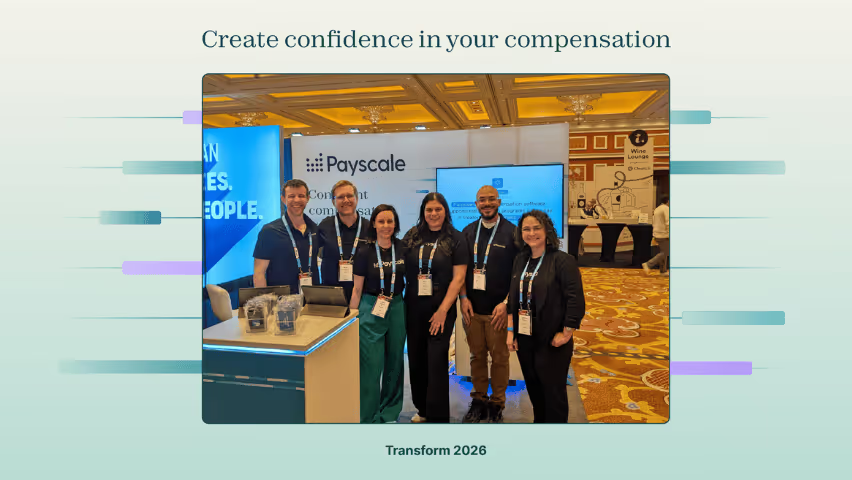
Our own Ruth Thomas, Payscale’s Chief Compensation Strategist, caught up with three compensation thought leaders on the ground at HR Transform 2026 in Las Vegas. Here’s what they had to say about pay-for-performance and what AI really means for the future of comp.
Peanut butter pay has been making headlines ever since Payscale’s 2026 Compensation Best Practices Report revealed 44% of organizations were thinking of spreading increases out evenly as Skippy.
Giving every employee the same pay increase regardless of performance has divided the HR community. Some cheer the end of pay-for-performance as a “useless corporate ritual” that should’ve died years ago. Others fret the potential flight risk of top performers when the job market lifts off again.
Whatever your point of view, the fact that close to half of organizations are trending in this direction is worth paying attention to.
We took to the floor at Transform 2026 and blew on our proverbial dice in the hopes of gaining perspective from some of HR’s heaviest hitters.
“It demotivates people”
Jessica Winder, Chief People Officer at Winder Law, didn’t mince words about peanut butter pay increases.
“It does and doesn’t surprise me,” she said when we shared the 44% figure. “It does surprise me because we’ve seen it not work before.”
For Winder, the problem with peanut butter pay increases isn’t so much financial as motivational.
“It demotivates people,” she explained. “It makes people feel like, well, this person isn’t doing as much as me, but we’re getting the same increase. Some might think it fair in theory, but I’ve never seen work out in practice.”
So what does work? Winder boils it down to one word: transparency.
“Are you actually telling people that you’re doing pay increases based on a rating? You're getting this performance rating and you’re getting this pay increase? Or have you decoupled them?”
She noted she’d attended a session at Transform where someone proposed completely separating performance reviews and increase cycles. Running them on entirely different timelines.
“To me that sounded kind of radical,” she admitted. “I’ve never done it that way. But I’m not opposed to it.”
What Winder opposes is keeping compensation decisions opaque. Not telling employees pay increases are tied to performance.
“I don’t think that’s going to do anything,” Winder said. “I think it’s actually going to make people want to leave.”

“People are going to go looking for the jelly somewhere else”
Joey Price, CEO of Jumpstart HR, came at the same issue from a different angle: the economic argument.
Price expressed sympathy for employers confronting a difficult macroeconomic environment.
Peanut butter pay increases are the “equivalent to a cost-of-living adjustment,” he explained. “Your plane tickets are higher, your gas prices are higher, and your Oreo cookies are getting smaller, but the price is staying the same. It seems like an effort by employers to navigate the reality of a pretty tough economy.”
Although sympathy doesn’t equal endorsement. Price argued that peanut butter pay increases might work in the short term but are a mistake in the long run.
They don't work because employers can’t predict the labor market.
“We don’t get to time the market,” Price said. “We don’t know when the market will swing from being an employer market to a seeker-friendly market. Peanut butter pay increases are a dangerous strategy to lean into because while employees are job hugging now...when that pendulum swings, people are going to look for the jelly somewhere else.”
The job hugging phenomenon characterized employee job-seeking in 2025. In our sluggish labor market, employees are staying put. Regrettable turnover isn’t happening as frequently now. But it will the moment employees have somewhere better to go.
Price points to the danger of losing top performers with undifferentiated pay increases.
“It’s not going to motivate high performers. They’re thinking, well gosh, I busted my butt. I worked weekends. I worked evenings. And while I was trying to build the business, my share of ‘peanut butter’ is the same as everyone else.”
Price framed strong performance management as connecting every employee to an organization’s mission: from C-suite to frontline workers.
He referenced an anecdote about JFK visiting a NASA rocket launching facility and asking a janitor what he did. The janitor’s answer: “I’m here to put a man on the moon.”
“If you can’t talk about performance in the context of moving the ball down the field or scoring organizational wins” that’s a missed opportunity, Price explained.
“Clarity is a gift. Feedback is a gift. The more you can tell your employees: hey, you’re doing a great job, and I can tell you why. Or you’re not doing a great job, and I can tell you why. They’ll be better for it.”

“AI can’t introduce risks to how you pay people”
We’d be negligent if we didn’t talk about AI. After all, the theme of this year’s Transform conference was “The Human + AI Equation: Forging the Next Era of Work.”
We also sat down with Kyle Forrest, Future of HR Leader at Deloitte. He brought a measured and strategic perspective to the AI hullaballoo in HR.
Deloitte’s 2026 Global Human Capital Trends report surveyed over 9,000 respondents across 70 countries. It found organizations were spending 93% on AI technology and only 7% on the “human side” of the transformation.
Forrest argued that this ratio needs to shift if organizations want to unlock AI’s true potential. In compensation specifically, he views AI as an opportunity for HR practitioners to do more strategic work.
“Look at total rewards professionals,” he said. “I was spending a lot of my time” doing work AI replaces. “Now I can spend more time with recruiters negotiating offers or business leaders allocating budgets. Things that actually impact the business.”
Forrest is also paying close attention to how organizations are (or aren’t) treating AI skills as a compensable factor. Payscale’s own research found that 51% of organizations are identifying AI skills but aren’t paying more for them.
Forrest sees that as a big miss.
“If I use AI to do work faster, better, differently...do I get paid more? Do I get a bigger bonus? Does my career path accelerate? These are some very fundamental questions that organizations need to ask and answer."
He pushed the thought to extreme: “If I’m a 10x worker, which is a term tossed around for people who are truly using AI differently, am I getting paid 10x compared to my peer? If Person A makes $100,000 as a recruiter, and Person B is a 10x recruiter, are they making a million dollars?”
Forrest chuckled: “I haven’t run across a recruiter making a million dollars. But these are the critical questions in compensation that need to be addressed.”
Skills-based pay, he noted, is complex in the era of AI. The challenge isn’t just identifying AI skills but knowing how much to pay for them. This is a burning question given how quickly technical skills depreciate.
“At the beginning of 2026,” he said, “I might pay for a ‘hot skill’ that’s very different come July or December. I don’t think anyone has attached a skill premium to enduring human capabilities. What does it look like to pay for someone with better judgment or critical thinking? Organizations are still grappling with this.”
Perhaps the most important thing that came out of our conversation was AI risk and governance in compensation decisions. Forrest was direct. Pay is one of the most personal things for employees. Getting it wrong introduces compliance risks and erodes trust.
“For compensation professionals, the most important thing is being clear on explaining the data you’re using to train AI models. Who has access to the data? Who’s training the outcomes? Because what does every worker want taken care of at their company? Their pay. You don’t want AI to introduce risks in how you pay people.”

Final thoughts
Whether it’s the short-termism of peanut butter pay increases or AI governance, HR has their work cut out for them in 2026.
Three themes stood out in our conversations: Employees need genuine transparency in how pay connects to performance. Structures that reward performance rather than smooth it over will win out in the end. And AI means smartly rewarding those with the right skills, while acknowledging the risks of artificial intelligence in compensation decisions.
If you missed us at Transform this year, we’d love to connect about all this and more.