

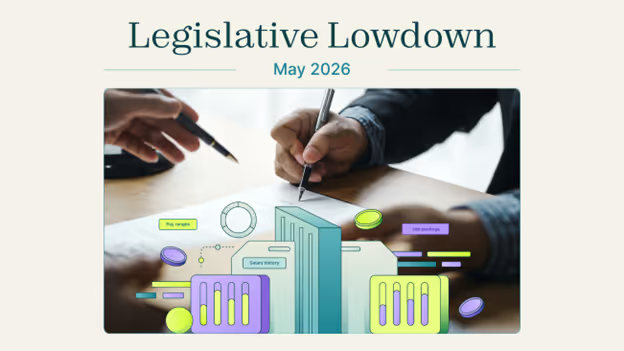
May 2026 pay transparency laws: key dates at a glance
Use this table to quickly identify new pay transparency legislation and salary transparency laws.
EU Pay Transparency Directive legislative update
May is the month of International Workers’ Day, a time to reflect on workers’ rights that have been gained over time. It is therefore ironic that the biggest shake up of pay transparency in Europe has not materialized as expected! Instead of all 27 EU member states, plus a few other European countries, implementing the EU Pay Transparency Directive on time, we have two, plus two very close.
The deadline for implementation (June 7, 2026) was known three years ago. Seventy-three percent of the EU Parliament, from across the political spectrum, voted for it. Some countries, such as Sweden, Netherlands and Denmark, provided early drafts and it all looked good timewise.
But now they pulled the brakes! We have only four countries that will probably be on time, with quite a few saying they will be ready January 1, 2027 (e.g. France, Czech Republic, Netherlands) and some who haven’t even provided a draft yet.
Here is a link to our Pay Transparency Legislation Tracker to keep abreast with what is happening in each country: https://www.payscale.com/featured-content/pay-transparency-legislation
As a reminder, the EU Pay Transparency Directive (EUPTD) has three main components:
- Candidate transparency (salary ranges on job postings or prior to negotiation; salary history ban; collective bargaining agreement information provided to candidates)
- Employee transparency (pay setting and progression criteria; right to information on individual pay and average pay by gender for the employee’s category; pay secrecy bans)
- Reporting (pay gap reporting for companies with 100+ employees at both entity and category-of-worker level; joint pay assessments if pay gaps in any category exceed 5%)
The whole EU Pay Transparency Directive is in support of the principle in the EU treaty of equal pay for equal work or work of equal value. Employees need to group their jobs, using gender-neutral job evaluation or classification, into ‘categories of workers’ or groups of equal value. This is a heavy lift for many companies without clear job architecture.
Although there is a delay in implementation, it does not mean that it is going away. The EU Commission has been clear that they are fully behind the Directive. Therefore, if you have any employees in any EU countries, you may have had a reprieve but use the extra time to prepare
U.S. pay transparency legislative update
In the United States, some states are still forging ahead with pay transparency laws, with Virginia and Maine coming into effect in July and Connecticut in October.
Virginia is first up, with its new law coming into effect on July 1, 2026. The law requires good faith pay ranges in both public and internal job postings and a ban on salary history questions. It applies to all employers and there isn’t much time to get ready.
Maine’s pay transparency law takes effect on July 29, 2026. Employers with 10 or more employees must include good faith pay ranges in job postings, though the law does not clarify whether this applies to internal postings. The legislation also gives employees the right to request the pay range for their role and requires employers to retain pay history records for three years after employment ends.
This law applies to all companies with 10 or more employees. It isn’t clear whether this is 10 in Maine or 10 in total. It is probably best to prepare for the latter!
Finally, Connecticut will join the pay transparency ranks on October 1, 2026. They are requiring good faith pay ranges and benefits on both public and internal job postings. The addition of benefits makes this one a bit more complicated. There is no minimum employee threshold.
Pay transparency legislation elsewhere
In addition, Bermuda is moving forward with pay transparency legislation too. They are in the consultation phase now, but we’ll keep an eye on it.
A recent OECD report suggests that pay transparency legislation will be in place across most OECD member countries by the end of this year. However, this does include the assumption that all EU countries will implement the Directive on time. Wherever you look, pay transparency is expanding globally.
May 2026: Pay transparency takeaways
It might not be the May we expected given the June deadline for the EUPTD, but pay transparency activity is continuing to increase. Instead of a big bang, we can think of the EUPTD as pushing organizations toward a ‘soft launch’. As one of the first countries moving toward implementation, Italy may provide an early indication of how employers can prepare for broader EUPTD compliance. Many organizations are thinking of providing more information to employees and candidates after June. It isn’t required so instead is a test of the water. Once transparency is required there may be no time to review.
Also, if you haven’t got your job architecture and systems ready to deal with transparency, you have gained time to work on it. Use this time wisely!
If you need any support with pay transparency compliance, Payscale is here to help.