

.avif)
Summary
Compensation plays a central role in whether employees remain in their current jobs or seek opportunities elsewhere. While 2026 has been shaped by a cooling labor market, lower pay increases, and job insecurity from AI disruption, employees with in-demand skills have greater visibility into higher-paying opportunities due to pay transparency. To stay competitive, HR teams must monitor market trends, proactively manage job descriptions, and make pay adjustments for in-demand skills before attrition begins to impact the organization.

Stay or go? How compensation drives flight risk
In employment, a flight risk reflects the likelihood that an employee will leave when external market compensation for similar work exceeds what they are currently paid.
%20(1).png)
What is a tenured advantage?
A tenured advantage exists when experienced employees are paid competitively enough that staying is financially rational. On average, jobs with a tenure advantage earn 6.1% higher pay than new hires in 2026, or -6.1% less.
What is a new hire market advantage?
A new hire market advantage occurs when external pay for new hires exceeds internal pay for the same work. On average, jobs with a new hire market advantage earn 3.6% higher pay than tenured employees in 2026.
Top issues impacting compensation advantages
Context matters when evaluating flight risk and retention strategy, especially when it comes to compensation management. In 2026, three forces are shaping how this plays out for employers: job hugging, artificial intelligence (AI), and pay transparency.
Job hugging: stability driven by caution, not satisfaction
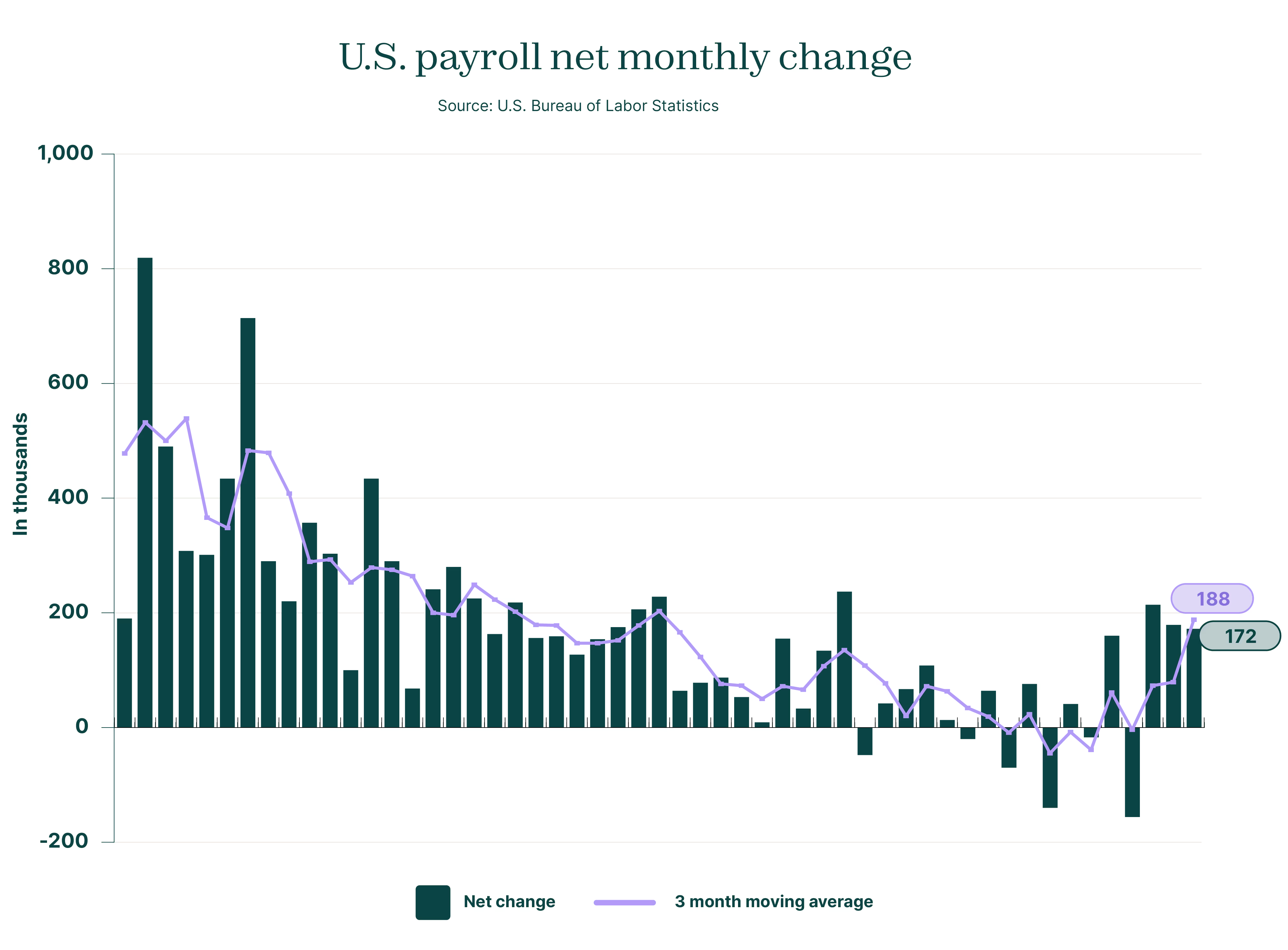
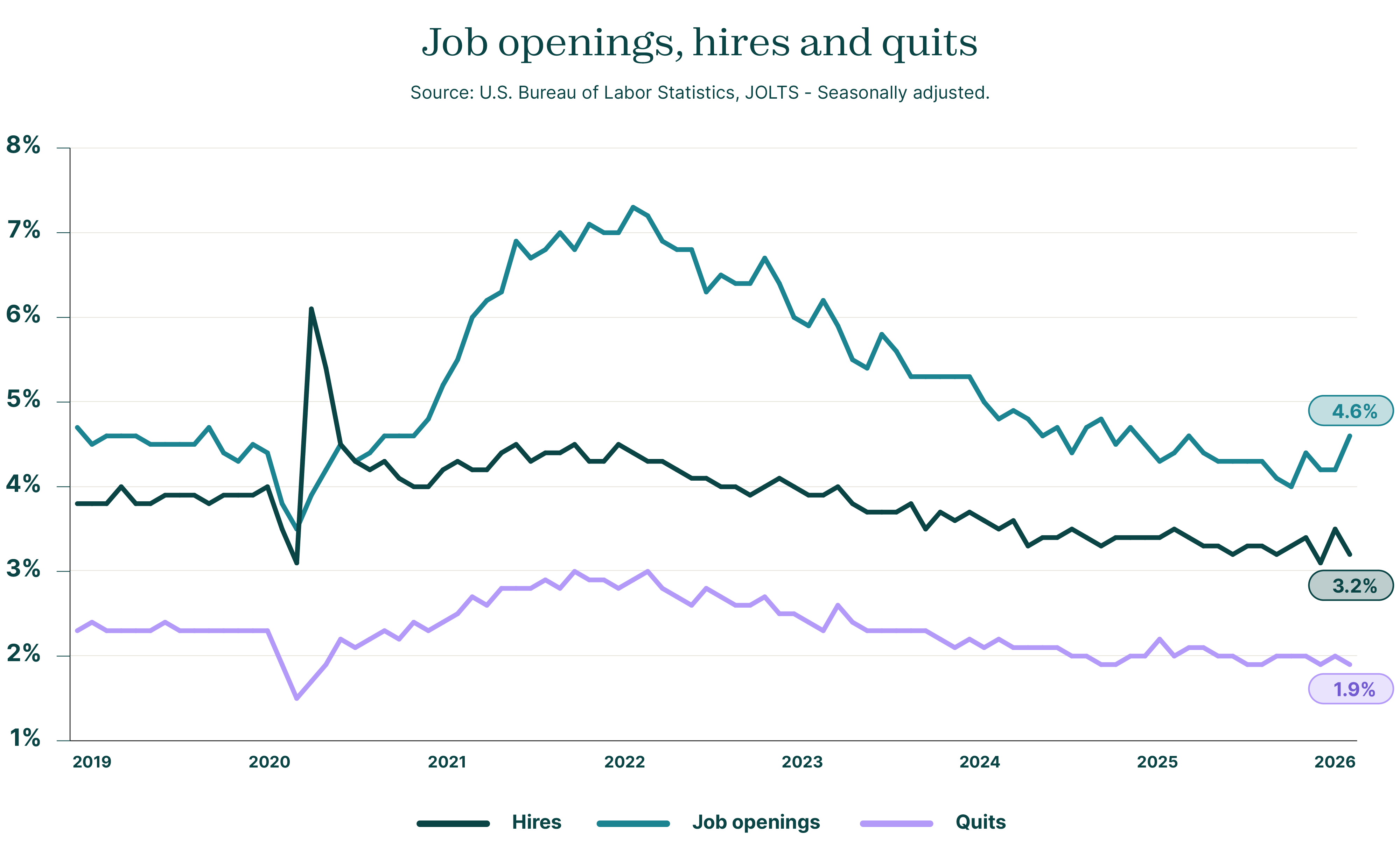
Today's labor market gives employers more leverage. Opportunities are few. Job applicants are plentiful. Job gains are low. However, when employees stay due to uncertainty, organizations see a decline in morale and discretionary effort. Attrition accumulates as disengagement when talent feels undervalued. This can lead to a mass exodus when the market turns around, which early signs of recovery may be pointing toward.
Artificial intelligence and the changing value of skills
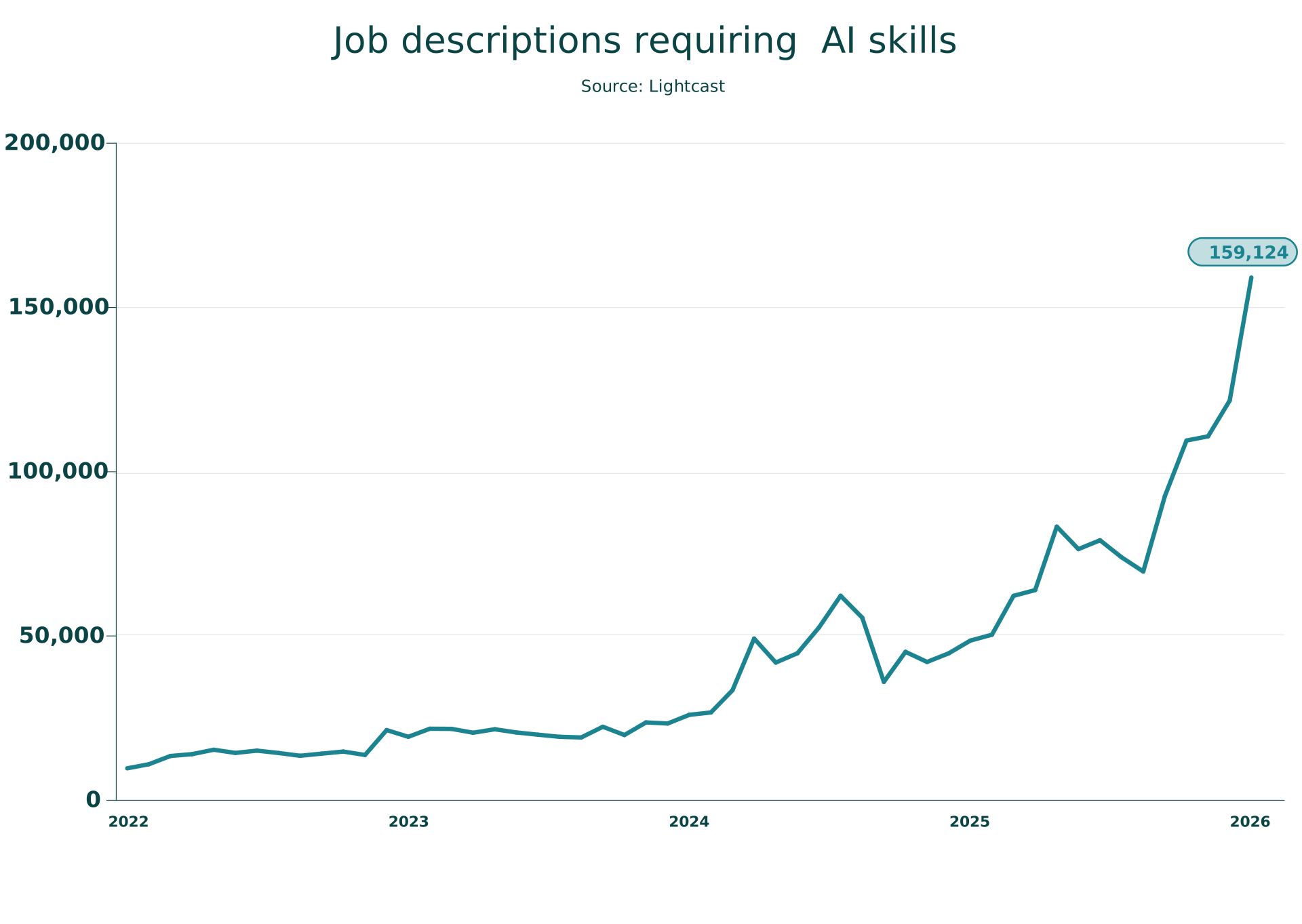
AI adoption is reshaping the job market faster than most compensation systems can track. Employees are increasingly expected to use AI tools and expand technical capabilities as part of their existing roles. However, pay structures still reflect traditional job descriptions rather than skills-based realities. The disconnect can be a hidden driver of attrition.
Pay transparency is accelerating market awareness
Pay transparency laws and the growing availability of compensation data have fundamentally changed how employees evaluate their pay. Workers now have greater visibility into salary ranges, external market rates, and pay differences between new hires and existing employees.
.avif)
Top 10 jobs where staying pays more
The top jobs with a tenure advantage are roles in clinical settings that require human-centered judgment, specialized certifications, institutional knowledge, or relationship-based work. Because they depend heavily on hands-on experience and contextual decision-making, AI is less of a threat.
Top 10 jobs where leaving pays more
The top jobs with a new hire market advantage require strategic decision-making, analytical expertise, product ownership, or cross-functional skills. AI may also be reshaping skills for these jobs, which is resulting in higher pay on the market than pay increases internally.
Interesting flight risks in specific job families and industries
Payscale also analyzed the top job that is a flight risk for each job family and industry. The full report contains a complete list. Here are some of the most surprising and newsworthy.
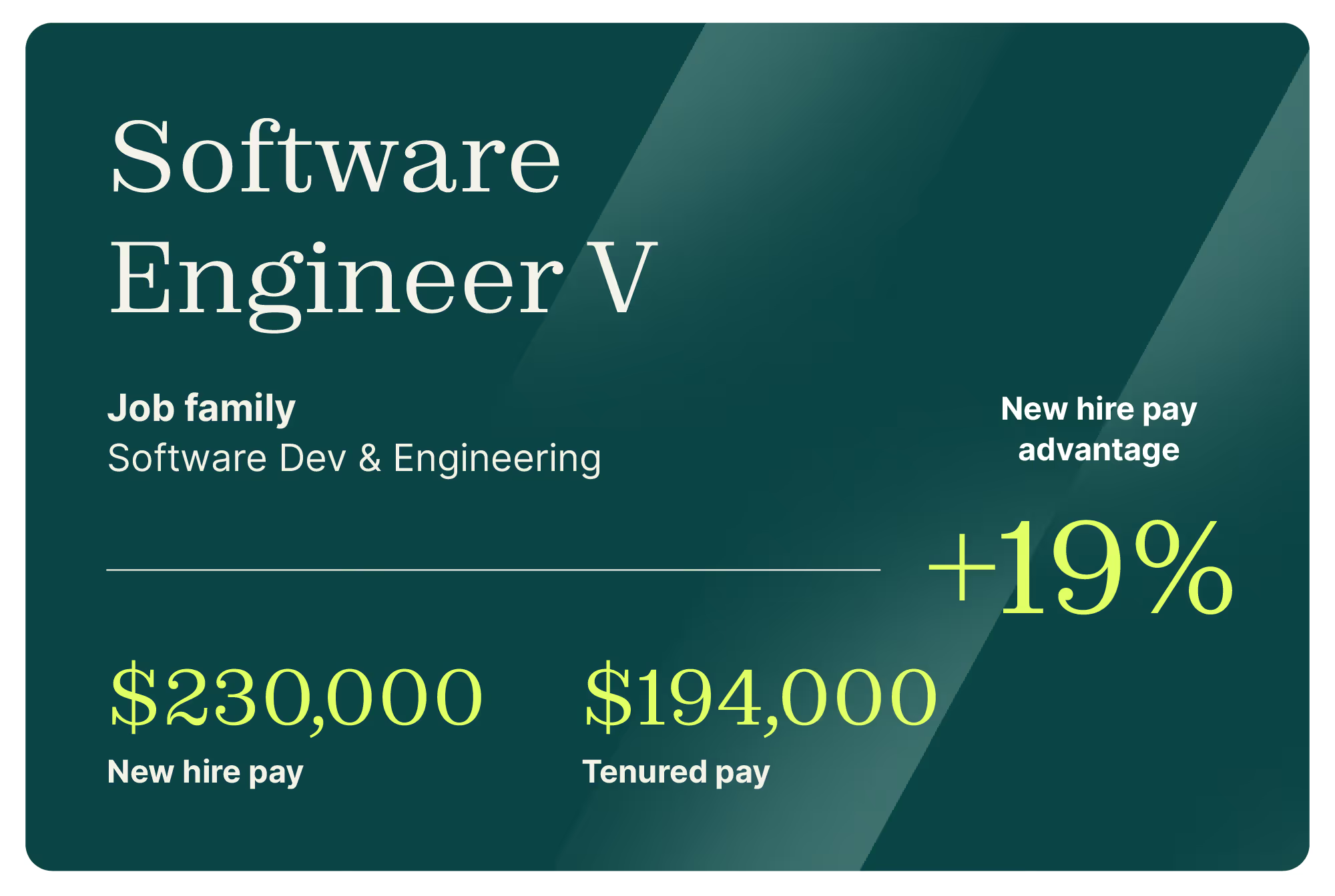
Despite headlines about AI replacing developers, senior software engineers are commanding the highest premiums on the open market within the software development job family. AI has created a bifurcated market for software developers, with entry-level coding under threat of replacement by AI in the narrative, but with actual demand varying by industry and level.
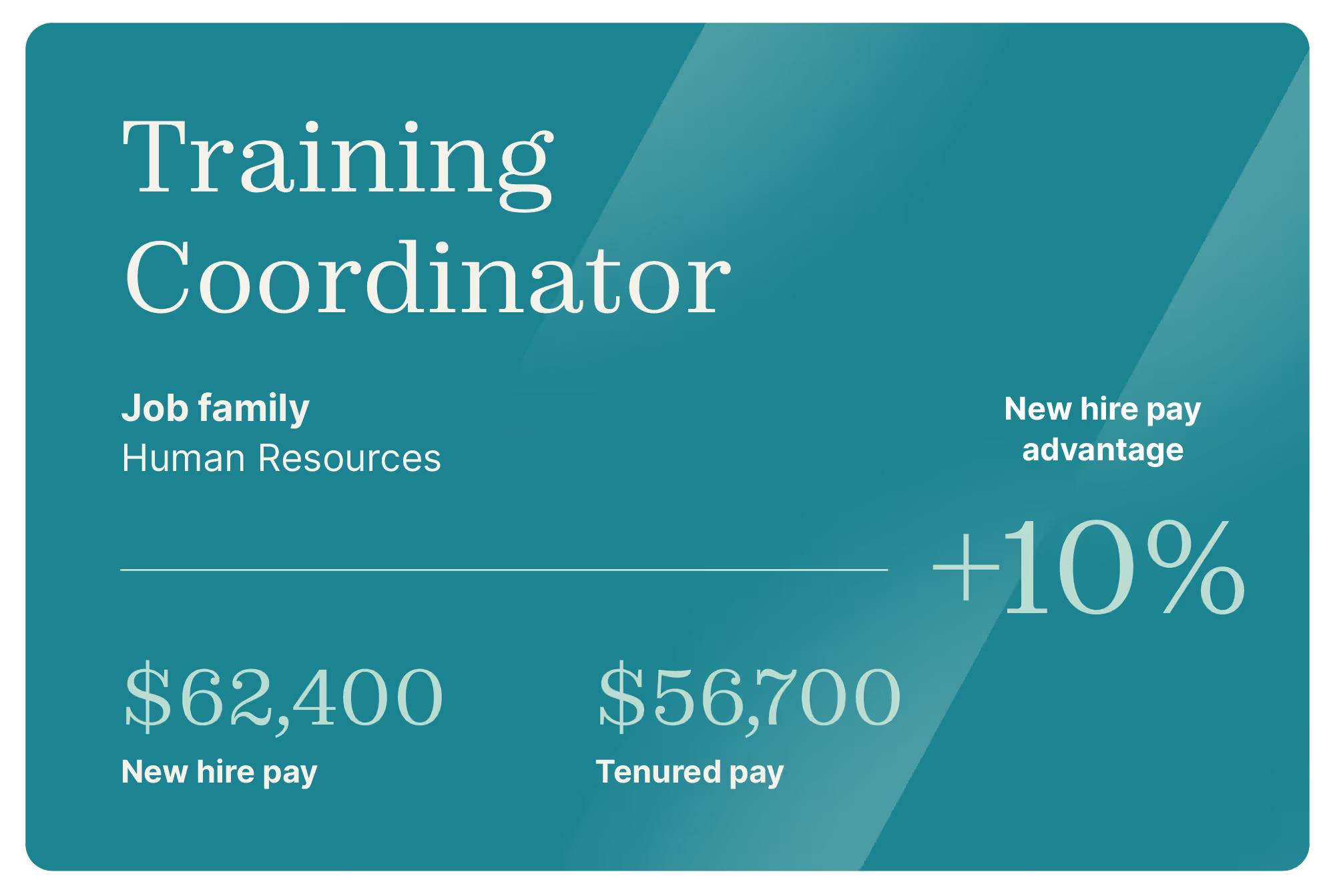
As AI reshapes jobs,employees need some level of AI upskilling. HR teams are transforming from compliance functions into strategic transformation leaders, and Training Coordinators are needed for that shift.
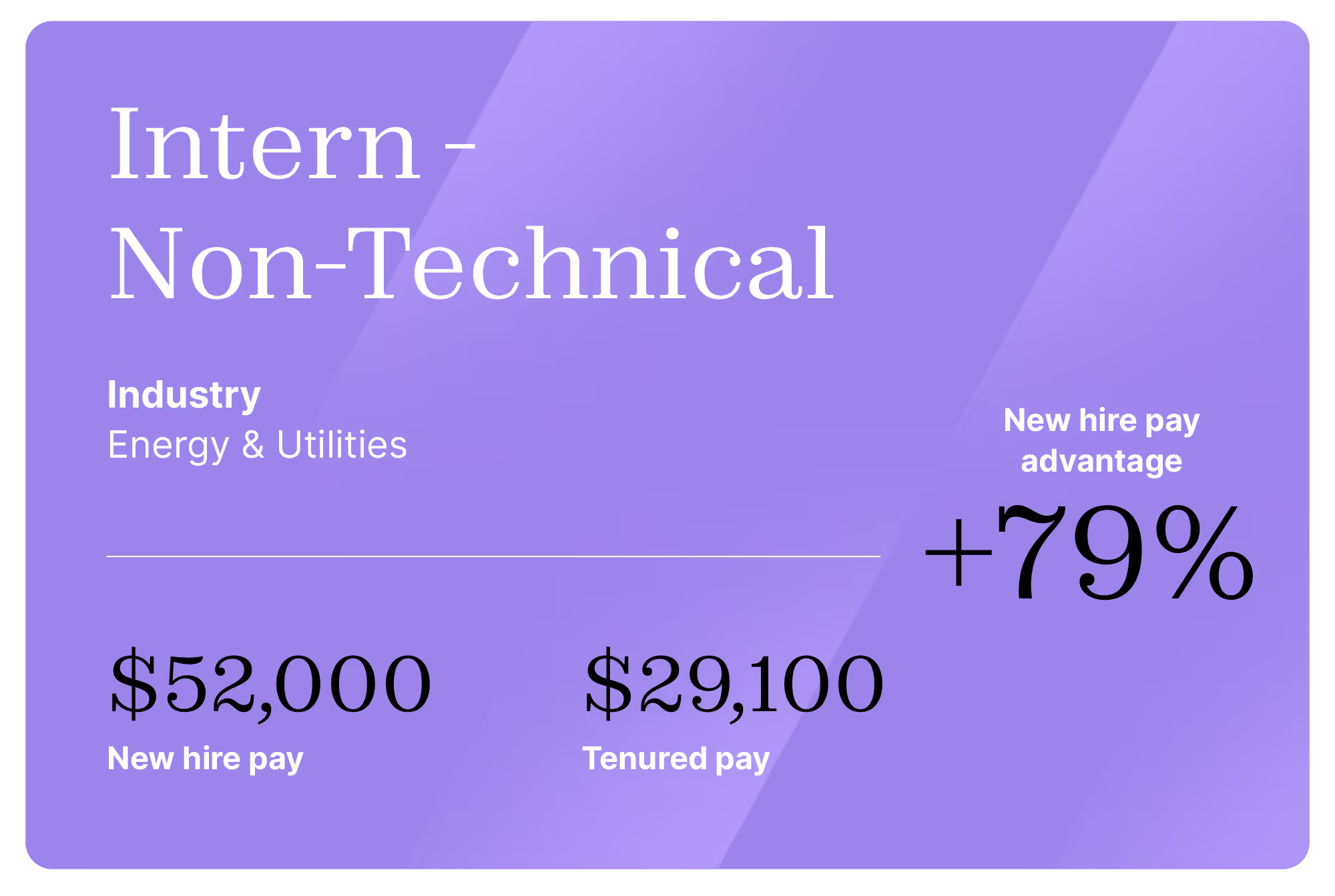
Despite widespread headlines about Gen Z job opportunities disappearing, interns earn more as new hires than tenured employees. Both Energy & Utilities and Manufacturing are paying premiums to attract younger workers, recognizing that an aging workforce and long-termlabor shortages make early talent acquisition essential for sustaining future operations.
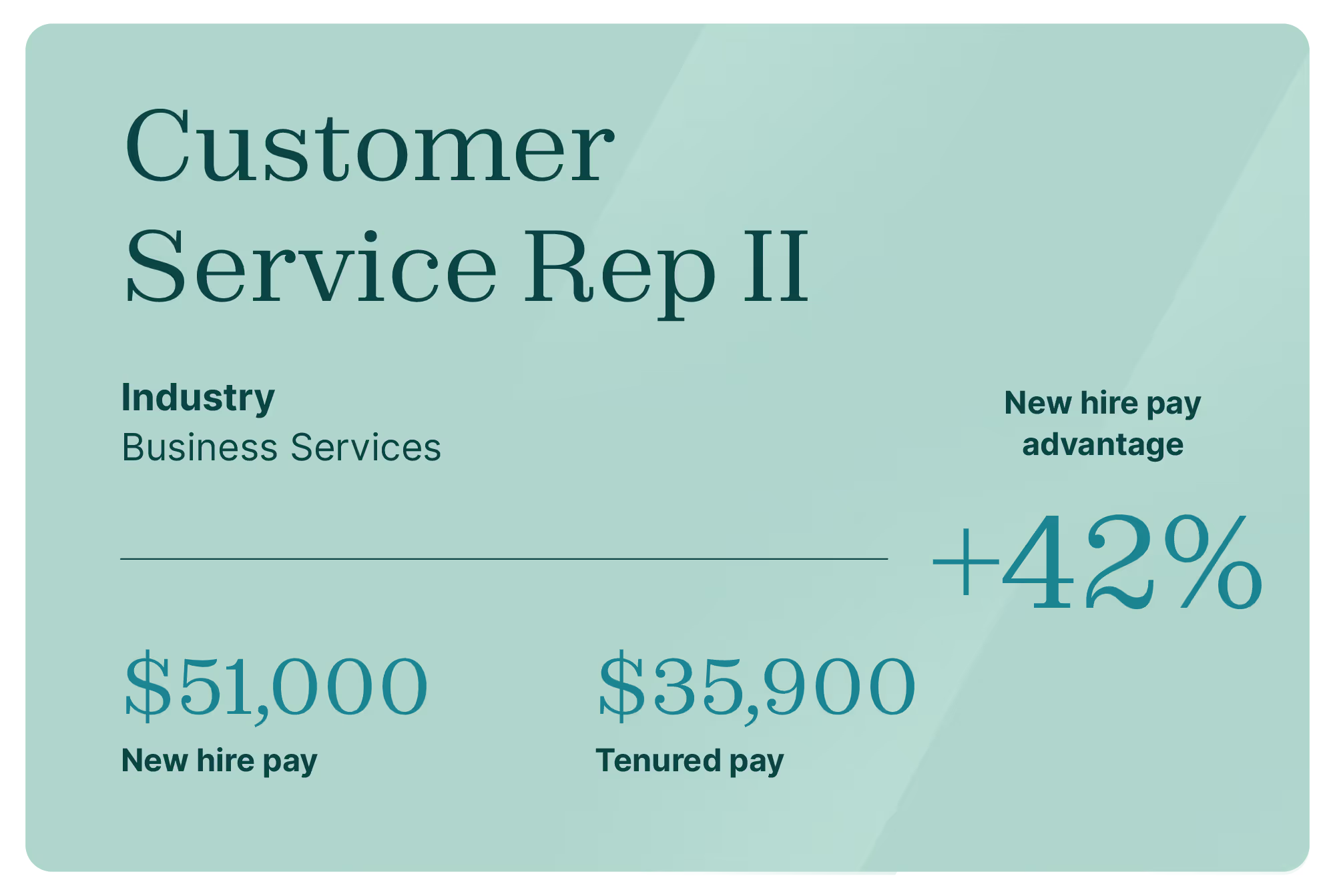
Despite AI-driven restructuring, organizations are paying more to hire CSRs in some industries, especially higher-skilled representatives for escalations, retention, and complex customer issues, resulting in new hires commanding a premium.
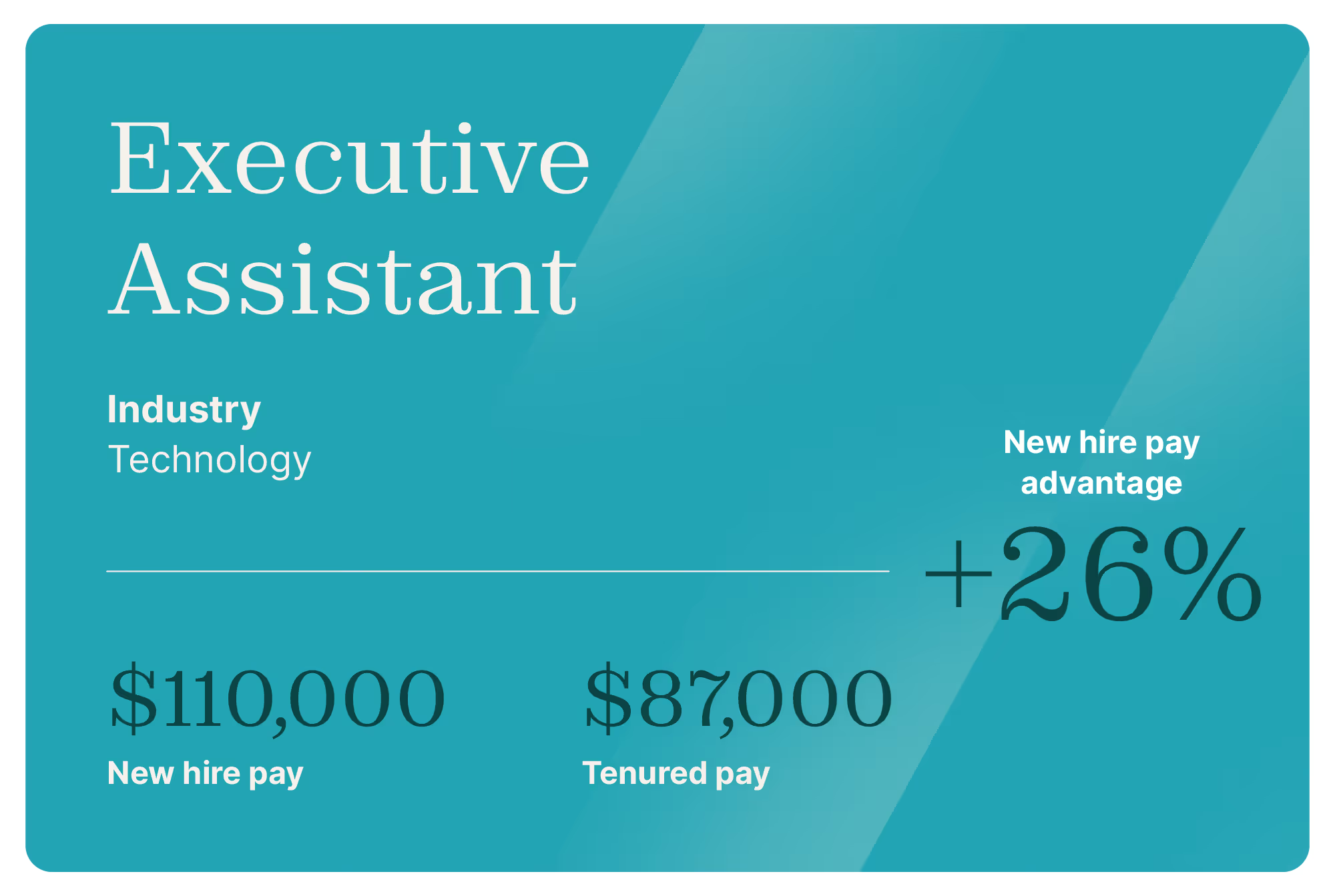
Counter to the narrative that AI will eliminate administrative roles, Executive Assistants take the top spot in the technology industry, earning 26% more on the open market. Executives still depend on the human judgment, discretion, and coordination of EAs, and may be struggling to attract and retain this talent given fears around job security.
Flight risk by job family in aggregate
When we look at job families at an aggregate level, 2026 looks more like a job hugger's market where flight risk is mitigated. Every job family shows that there is a tenure advantage where employees out-earning new hires — in some cases by a wide margin. Healthcare and Research & Development top the list, with tenured employees earning 37% more than new hires on average. Even in Software Development & Engineering, where individual senior roles command significant market premiums, the job family as a whole still favors tenure by 15%.
For HR and compensation teams, this is an important counterweight to flight risk analysis, suggesting that retention, not recruitment, is where compensation dollars have the most impact, and why compensation planning around pay increases is so important.
Why HR can't wait for the next annual comp cycle
Across both market-advantaged and tenure-advantaged roles, the challenge is the same: most traditional compensation systems are moving too slowly to keep up with the pace of change. As AI reshapes work and pay transparency increases market awareness, organizations should:

Benchmark jobs more frequently
Move beyond annual reviews for market-sensitive and AI-impacted roles.

Modernize job architecture
Update job descriptions and career paths to reflect how work is evolving with AI.

Link pay to skill growth
Reward employees for developing high-value skills through targeted increases and skills differentials.

Watch for internal pay compression
Evaluate whether incumbent employees are falling behind rising new hire pay.

Treat pay gaps as an attrition signal
Monitor engagement and external market gaps alongside attrition metrics.

Communicate proactively
Explain how jobs may evolve and what new skills are worth in the era of AI.
Download the Flight Risk Report
The full report includes a complete ranking of tenure-advantaged and market-advantaged roles, analysis of flight risk by job level, and a breakdown of the top at-risk job in every major job family and industry in the U.S.

Methodology
Payscale showcases the top jobs with a new hire "market advantage," whose paycheck may benefit the most from seeking new employment and likely the biggest flight risks for employers. Not all jobs have flight risk; some see a “tenure advantage” — where seniority and institutional experience are rewarded.
We present these top advantage jobs, and the top flight risk jobs by job family and industry, using Peer — our proprietary data set of fresh, HRIS salary data and features:
- 10.2 million incumbents
- 4,500 Peer network customers
- 36,000 jobs
The data is effective as of May 2026. Salaries reported are the U.S. national median and use a threshold of 40 incumbents for reporting.

New hires are defined as having a date of hire within the past year.
Tenured employees defined as those with a hire date for their role 13 or more months ago.
Pay differential is the percent difference in pay between tenured and newly hired employees for a given job title, or combination of job title, job family, and industry. Higher pay differentials are observed for certain jobs within particular industries or job families compared to overall analysis, as they are evaluated amongst a smaller cohort of employees.
Findings in this report are derived from Peer, Payscale’s proprietary survey-grade and HRIS-integrated compensation dataset. Peer is a continuously refreshed database constructed from employer-reported compensation and workforce records submitted directly from HR information systems. Data are at least 90 days old in aggregate, enabling a more timely snapshot into labor market conditions rather than relying on dated, annual survey cycles.
Peer data undergo a structured, multi-stage validation process prior to inclusion in the dataset. Participating organizations submit job and compensation records, which are matched to standardized Peer job classifications through AI-assisted job matching technology and manual review. Compensation data are then linked to matched roles and subjected to systematic quality controls, including outlier detection and age-of-data monitoring. Records that fail validation thresholds are excluded. Validated data are aggregated at the job level to generate market benchmarks, and outdated data are routinely removed to preserve temporal relevance while complying with data aging requirements.
Strict confidentiality safeguards govern all reporting. Each published data cut must include contributions from at least five organizations, and no single organization may represent more than 50% of the data within a reporting cell. Automated similarity checks prevent the creation of overlapping data cuts that could risk re-identification. These safeguards ensure that all outputs reflect aggregated market trends while preserving participant anonymity.
It depends on the role. Jobs with a tenure advantage pay tenured employees 6.1% more than new hires on average, so staying pays more — these are concentrated in healthcare, clinical, and specialized technical fields. Jobs with a new hire market advantage pay new hires 3.6% more on average, so switching can pay more — this is most pronounced in knowledge-based white-collar roles. Across job families in aggregate, every family pays tenured employees more than new hires, showing that in this job market, staying often pays more than leaving.
Job hugging is when employees stay in their current roles out of caution rather than satisfaction, driven by slow hiring, reduced quit rates, and a cooling labor market. Low turnover can look like stability, but it may mask disengagement that surfaces as a wave of attrition when the labor market turns around.
Payscale is the original compensation innovator for organizations who want to scale their business with pay and transform their largest investment into their greatest advantage. With decades of innovation in sourcing reputable data and developing AI-powered tools, Payscale delivers actionable insights that turn pay from a cost to a catalyst. Its suite of solutions — Payfactors, Marketpay, and Paycycle — empower top companies in the U.S. and businesses like Cintas, Leidos, Chipotle, Brookdale Senior Living, Ohio State University, American Airlines, and TJX Companies.
Create confidence in your compensation. Payscale.
To learn more, visit www.payscale.com.