



Uber just cut 23% of its People division. IBM says AI now handles 94% of its routine HR tasks and has eliminated hundreds of HR and recruiting roles. Meta reduced its talent acquisition team whilst simultaneously funding a $600 billion AI infrastructure push. Google, Microsoft, and Klarna have all done versions of the same thing.
This is not a trend. It is a reckoning. And it raises a question that most companies are not asking carefully enough: when you strip HR down to the bones, what exactly are you cutting …and what are you keeping?
The recruiter collapse is a canary in the coal mine
The numbers are stark. According to Lightcast data, active US job postings for recruiters peaked at around 17,800 per month in early 2022. By 2026, that figure had fallen to roughly 3,200 — an 80% decline.
But here is the part that gets glossed over in most AI narratives: that collapse did not start with ChatGPT. It started when interest rates rose, companies braced for recession, and hiring froze. AI accelerated the story and gave it a cleaner headline, but the structural cause was simpler. When a team's job is to grow headcount and headcount growth stops, that team becomes visible as overhead.
Recruiting is the most transactional slice of HR, and it has always been the first to feel the squeeze. That is worth remembering when we extrapolate to the rest of the people function.
AI is a genuine HR disruptor
Let's not pretend AI is not doing real work. Resume screening, onboarding workflows, benefits administration, initial data processing — these are legitimately automatable. IBM's 94% figure for routine HR task automation is not spin. It reflects what happens when you apply modern AI tools to a function that was historically very process heavy.
Klarna is the instructive case here. The company phased out Workday and Salesforce in favor of custom generative AI tools and dramatically shrank its HR-related costs. Then it quietly admitted it had pushed automation "too far" and had to rehire human workers. That admission is more important than the original announcement. It tells you where the edges of automation actually are.
AI is genuinely good at tasks that are well-defined, repeatable, and data-driven. It is not good at the parts of HR that require relationship building, judgment, institutional knowledge, employee trust, and organizational context. The challenge is that most companies are cutting both — the routine work and the strategic work — because the budget pressure does not distinguish between them.
There is a logic to these cuts. It is also short-sighted
When headcount growth slows, recruiters become overhead. When administrative tasks are automated, generalist HR coordinators become overhead. This is the internal logic that is driving these reductions, and at a surface level, it holds.
But that framing treats HR purely as a delivery mechanism for headcount and paperwork. It ignores what else the people function actually does — and what happens when those capabilities are gone.
People strategy is not the same as recruiting. Compensation management is not the same as processing an offer letter. Employee retention, workforce planning, pay equity analysis, performance calibration, organizational design — these are not tasks you can automate away and expect to have a functional business on the other side. They require data, judgment, and dedicated infrastructure.
The companies cutting deepest right now are betting that AI can absorb those functions or that they are not critical enough to protect. Some will be right. Many will find out they were wrong at the worst possible time: during the next competitive talent market, the next labor dispute, the next round of attrition they did not see coming. The job market may seemingly favor AI-replacement now, but when the pendulum swings and business needs adapt to a different market — automated processes can be a risk.
Compensation is a human endeavor
Compensation is the clearest example of an HR function that looks like administration but is actually strategy. It is your single largest operating expense. It is the primary lever for attracting and retaining talent. And it is extraordinarily sensitive to market conditions that are moving faster than annual review cycles can track.
When companies cut the HR function and replace it with a patchwork of AI tools, comp can become a huge business risk. The dedicated comp analysts are gone. The data infrastructure investment is deferred. The quality of benchmarked jobs may degrade. The "we'll handle it with AI" assumption takes hold.
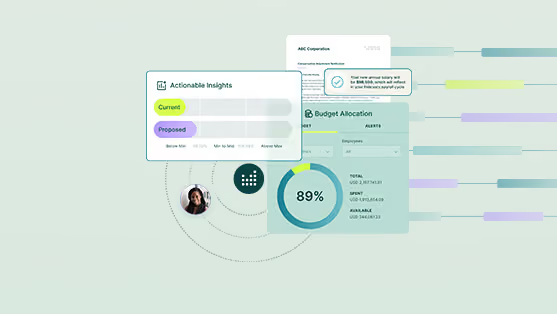
That assumption breaks down quickly. AI cannot set comp strategy. It cannot make the judgment call on a retention offer for a key engineer. Decisions like these are often an interdepartmental balancing act — with budget as a tight rope. It cannot tell you whether your pay bands are drifting out of market in real time unless someone has built the systems and processes to support that analysis. Purpose-built compensation software exists to help people handle the complexity, data requirements, and compliance dimensions of pay that scales with business growth.
What the pendulum swing tells us
Recruiter job postings have ticked up in recent months after the steep decline. That is a small signal, but it is worth taking seriously. It suggests some organizations are recognizing that they overcorrected — that the "AI replaces all hiring" thesis ran ahead of what AI can currently deliver.
The same pendulum is coming for the broader HR automation experiment going on in the market. The companies that cut deepest and fastest will spend the next few years rebuilding capabilities they should not have lost. The companies that treated AI as an enhancement rather than a replacement will be better positioned when the talent market inevitably tightens again.
There is real AI leverage in HR. Use it for the routine, the repetitive, the administrative. Build better data infrastructure. Automate the parts that deserve to be automated. But do not mistake the parts of HR that look like overhead for the parts that are actually structural to how your business works.
People are not a cost to be optimized away. And the infrastructure that manages people — done well — is one of the few genuine competitive advantages left. Strip it down too far, and you will feel it. Just probably not until it is expensive to fix.